


What Are Plate Tectonics? How Earth’s Plates Move
Plate tectonics is one of the most important processes that shapes the surface of our planet. Earth may look solid and unmoving, but its outer layer is actually divided into several large pieces called tectonic plates. These plates move slowly over time, and their movement creates many of the landforms and natural events we see around the world. Plate movement plays a major role in shaping Earth, from towering mountains to deep ocean trenches. It also causes many earthquakes and volcanic eruptions. But how do these huge plates move, and what happens when they interact?
What Are Tectonic Plates?
Earth has several layers. The outermost solid layer is called the crust. Beneath the crust lies part of
the upper mantle. The lithosphere is the rigid crust and uppermost mantle.
The lithosphere is divided into large pieces called tectonic plates. Some plates are made up mostly of oceanic crust, others have a lot of continental crust. There are a number of large ones including the African Plate, Eurasian Plate, Pacific Plate, North American Plate and South American Plate.
Those plates are not stationary. They move very slowly, usually only a few centimeters each year. The movement is very slow, but it can make big changes over millions of years.
Why are the Tectonic Plates Moving?
Movement of tectonic plates is caused by heat inside Earth. Deep beneath the surface, the Earth’s interior is extremely hot. It’s the heat that makes the mantle move.
Scientists describe the movement of the plates in a number of ways. One important process is mantle convection. Hot material rises; cooler material goes down. Other forces also contribute to the driving of plate motion, such as the sinking of dense oceanic plates at subduction zones and the spreading of plates away from tall ocean ridges. It’s like chunks of ice slowly drifting on water. You cannot see the movement in a short amount of time. But over a long time, the position of the pieces can change significantly.
Kinds of Plate Boundaries
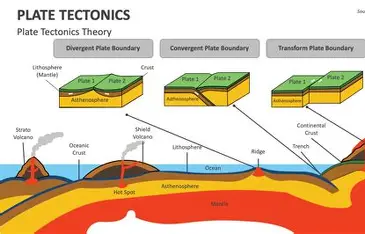
There are three main types of boundaries where tectonic plates meet. Each kind produces various geological features and events.
1. Types of Boundaries
A divergent boundary is where two plates move away from each other. When the plates pull apart, magma from below can rise and cool, forming new crust.
This process usually occurs at mid-ocean ridges. It helps to build new parts of the ocean floor.
2. Boundaries That Fit
Two plates move toward each other at a convergent boundary. The result is dependent upon the types of plates involved.
When a continental and oceanic plate collide, the oceanic plate is denser and can subduct beneath the continental plate. This is known as subduction. It can create deep ocean trenches, earthquakes and volcanoes.
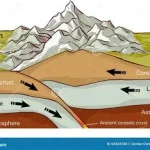
When two continental plates collide, neither plate sinks easily. Instead, the crust can buckle, creating great mountain ranges.
The Himalayas are a good example.
3. Conversion Limits
Two plates slide horizontally past each other at a transform boundary. They can put stress on faults.
An earthquake happens when the stress that has built up is suddenly released. Thus, transform boundaries are closely associated with earthquake activity.
How Mountains Are Made Through Plate Tectonics
Plate movement has created many of the world’s great mountain ranges. When two continental plates collide, the Earth’s crust can be folded and compressed.
Over millions of years this pressure can force up large areas of land. And the result is a mountain chain. The Himalayas continue to rise because the Indian Plate continues to ram into the Eurasian Plate. This means that plate tectonics is not just an ancient process but continues today.
How Plate Tectonics Causes Earthquakes
Earthquakes often occur when tectonic plates move against each other. Plates may become locked because of friction while pressure continues to build.
Eventually, the rocks can break or suddenly shift along a fault. This releases energy in the form of seismic waves, producing an earthquake.
The strength and effects of an earthquake depend on factors such as the amount of energy released, the depth of the earthquake, and the distance from populated areas.
How Plate Tectonics Causes Volcanoes
Volcanoes are also closely connected to plate tectonics. At some convergent boundaries, an oceanic plate sinks into the mantle. As it descends, it contributes to conditions that allow magma to form.
The magma can then rise toward the surface. If it reaches the surface, a volcanic eruption may occur.
Volcanic activity can also happen at divergent boundaries, where plates move apart and magma rises through the opening.
However, not every volcano is located directly on a plate boundary. Some volcanoes form above hot spots, where unusually hot material rises from deep within Earth’s mantle.
Why Is Plate Tectonics Important?
Plate tectonics helps scientists understand how Earth’s surface changes. It explains the formation of many mountains, ocean basins, trenches, volcanoes, and earthquake zones.
It also helps us understand that the continents have not always been where they are today. Millions of years ago, the continents were arranged differently. Over enormous periods of time, plate movement slowly changed their positions.
This movement continues today, although it is far too slow for people to notice in everyday life.
Conclusion
Plate tectonics is a powerful natural process that constantly changes Earth’s surface. The movement and interaction of tectonic plates can create mountains, ocean floors, volcanoes, and earthquakes.
Although plates usually move only a few centimeters each year, their effects become enormous over millions of years. By studying plate tectonics, scientists can better understand Earth’s history and the geological forces that continue to shape our planet today.

Comments are closed.
[…] form over millions of years. The main force behind many mountain ranges is the movement of tectonic plates. However, volcanic activity and other natural processes can also create mountains. […]