


What Is the Water Cycle? How Does Water Transform on Earth?
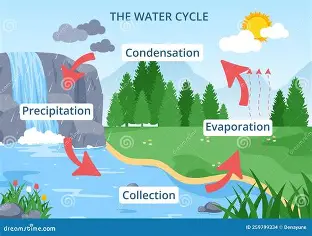
What is the process of the water cycle? The water cycles the process which water continually circulates in the Earth, the atmosphere, and below ground. Water is continually moving from place to place and changing its state, such as evaporating, condensing, precipitating, and collecting. It is a natural cycle whereby water circulates between oceans, rivers, lakes, soils, glaciers, plants, and the atmosphere.
Water on Earth is more or less invariable, but it is in a continually recycle state. The rainwater that falls today could have been in an ocean, glacier, river, or cloud thousands of years before!
Why Is the Water Cycle Important?
The water cycle is vital to life on Earth. Water is essential for all plant, animal, and human life.
The cycle transports fresh water from place to place on Earth. It also has significant importance in weather and climate. Water movement is relating rainfall, snowfall, clouds, humidity, and many other atmospheric processes.
The water cycle ensures the natural replenishment of freshwater in rivers, lakes, groundwater systems, and other freshwater sources.
Explain the Different Stages of the Water Cycle.
The cycling of water is not a single-pathway process. The movement of water can occur through a number of processes depending upon the environment.
These are evaporation, transpiration, condensation, precipitation, infiltration, runoff, and collection.
Let’s look at each process.
Evaporation: Water Rises into the Air
Evaporation is the chang of water from a liquid to water vapor.
Evaporation is mainly an energy-consuming process that is drive the Sun. Some water molecules turn into invisible water vapor evaporating from oceans, seas, rivers, lakes, and ponds when the energy of the molecules increases as the water is heat up the Sun.
One of the most important sources of water vapor in the atmosphere is the oceans, which cover a large portion of the Earth’s surface.
Other wet surfaces, such as soil, can also evaporate.
Water Lost from Plants in the Form of Transpiration
Another way that plants are involve in the water cycle is through transpiration.
Water is take plants via the roots. A portion of this water is used for growth and other biological functions. A lot of this eventually evaporates from the plant through the small openings in the leaves called stomata.
The water loss from evaporation and transpiration is sometimes referred to as evapotranspiration.
It puts water vapor into the atmosphere and links plants to the global water cycle.
Condensation: Clouds Begin to Form
As it moves into the air, water vapor may come across colder air.
As the water vapor cools, it can condense into small liquid water droplets or ice crystals. This is known as condensation.
They aggregate around minute particles in the atmosphere and thus become clouds.
Condensation is a significant process in the water cycle as it transforms invisible water vapor into something capable of forming precipitation.
Precipitation: When Water Falls Back Down to Earth
When water drops in clouds grow large and heavy enough, they can fall toward Earth’s surface. This is what is known as precipitation.
Precipitation comes in a variety of forms, such as:
- Rain
- Snow
- Sleet
- Hail
Precipitation can be in the form of rain, snow, or sleet, depending on the temperature and other factors in the atmosphere.
The most common form is rain; however, precipitation in colder regions is of particular importance, especially snow.
Collection: Water Returns to Earth’s Surface
Once water Falle the ground, it may pool in various locations.
Some water seeps into rivers, lakes, and wetlands. In time, most of this water migrates to the oceans.
In cold regions, snow can build up to form glaciers or ice sheets. Some precipitation is also trappe in the soil and groundwater.
These stores are significant components of the water cycle.
Infiltration: Water Goes into the Soil
Some rainwater does not run off the surface. Rather, it is absorbe into the ground.
This is known as infiltration.
Water is able to flow between particles of soil and particles of rock. Some of it percolates through to underground layers, where it becomes groundwater.
Groundwater may stay in the ground for a long time, migrating to springs, rivers, lakes, wetlands, or the ocean.
Runoff: Water Flows Across the Land
When rainfall or melting snow cannot soak into the ground quickly enough, water flows across the surface. We call this surface runoff.
Gravity pulls the runoff downhill. The water may flow into streams or rivers and eventually reach a lake or an ocean.
Heavy rain or rapid snowmelt can create large amounts of runoff and increase the risk of flooding.
Excessive runoff can also cause flooding, especially when the soil cannot absorb more water or urban surfaces prevent water from seeping into the ground.
How Is the Water Cycle Powered by the Sun?
Many aspects of the water cycle depend on the energy of the Sun as the primary source of energy.
When the Sun’s energy reaches the Earth’s surface, it results in evaporation. It also helps transport water to plants and control the atmosphere.
Another force is gravity. It promotes the release of precipitation from clouds and the movement of water downhill in streams and rivers and through the groundwater system.
Solar energy and gravity play a role in the global transport of water.
Is There an End to the Water Cycle?
The water cycle is a natural process that is continually repeated. It is not well defined in terms of when it starts and finishes.
A molecule of water can evaporate from the ocean and enter a cloud, then fall as rain, enter a river, and finally return to the ocean. Another molecule may enter the groundwater supply and stay there for decades, centuries, or longer.
Another way for water to froze and released to the environment is in glaciers, where it is frozen and released when temperatures increase.
Scientists call it a cycle because water constantly moves from one place to another.
The Water Cycle and the Effects of Human Activities on It
Human activities can affect different parts of the water cycle.
Deforestation may affect the amount of water plants release into the air, as well as surface runoff. There are also urban areas that have built up with roads and buildings, where there is less opportunity for rainwater to percolate through the soil.
Water movement is also affec agriculture, through irrigation and the use of groundwater.
Evaporation, precipitation, snow and ice, and freshwater supplies can impact climate change in various regions. These changes may impact the flow of water at the local and global levels.
Conclusion
The water cycle describes how water move from the Earth’s surface, underground, and the atmosphere. Water evaporates and transpires into the air, and the resulting condensation aids in cloud formation. Precipitation then returns water to the Earth’s surface, where it is able to collect, infiltrate into the ground, or run off.
This is a natural process of movement of fresh water around the planet that sustains life, ecosystems, weather, and climate. The water cycle, while apparently simple, is a highly intricate system that works throughout the global environment, linking oceans, land, air, plants, animals, and humans.

Comments are closed.
[…] পৃথিবী নিজের অক্ষের ওপরও ঘোরে। তবে পৃথিবীর এই অক্ষটি একেবারে সোজা নয়—এটি প্রায় […]