


How Are Mountains Formed? A Guide to Mountain Formation
How Are Mountains Formed? Mountains are some of the most impressive landforms on Earth. They rise high above the surrounding landscape and can take millions of years to develop. Most mountains form because of movements inside the Earth’s crust, especially the movement and collision of tectonic plates. However, volcanic activity, erosion, and other geological processes can also create mountain landscapes.
Understanding mountain formation helps us learn more about Earth’s structure and the powerful forces that constantly reshape our planet.
What Are Mountains?
A mountain is a large natural elevation of Earth’s surface that rises significantly above the surrounding land. Mountains usually have steep slopes and a high point called a summit or peak.
Mountains can occur alone, but many form part of larger ranges. The Himalayas, Andes, Rockies, and Alps are examples of major mountain ranges.
Their height, shape, and structure depend on how they formed and how geological processes have changed them over time.
The Role of Tectonic Plates
The movement of tectonic plates plays a major role in mountain formation. Earth’s outer layer is divided into several large plates. These plates move slowly over the hotter, softer material beneath them.
The movement may seem extremely slow, but its effects become enormous over millions of years. How Are Mountains Formed?
When plates collide, they can push, fold, or break Earth’s crust. In some regions, this pressure forces large areas of land upward and creates mountains.
This process is responsible for many of the world’s great mountain ranges.
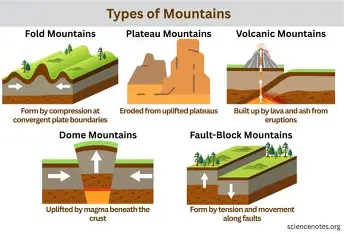
Fold Mountains
Fold mountains form when tectonic plates push against each other. The pressure can compress layers of rock and cause them to bend and fold.
The Himalayas are a famous example. They formed as the Indian Plate moved toward and collided with the Eurasian Plate.
The collision continues today, which means the Himalayan region remains geologically active.
Fold mountains often contain long ridges and deep valleys. Their landscapes can become even more dramatic through erosion caused by rivers, glaciers, wind, and weather.
Fault-Block Mountains
Some mountains form when large blocks of Earth’s crust move along faults.
A fault is a fracture in Earth’s crust where rocks can move. Strong forces inside the planet can push some blocks upward while other blocks move downward.
The raised blocks can become fault-block mountains.
This type of mountain formation often creates steep slopes and relatively straight mountain ranges.
Volcanic Mountains
Volcanic activity can also create mountains. When magma rises from inside Earth and reaches the surface, it can erupt as lava, ash, and other volcanic materials.
Repeated eruptions can build layers of volcanic rock around a vent. Over time, these layers can form a volcanic mountain.
Mount Fuji in Japan is a well-known example of a volcanic mountain.
Volcanic mountains can remain active for thousands of years, while others become dormant or extinct.
Dome Mountains
Dome mountains develop when magma pushes upward beneath Earth’s surface without actually breaking through it.
The pressure from the rising magma can cause the rock layers above it to bulge upward, creating a dome-shaped landform.
Later, erosion can remove the softer layers around the uplifted area. This can expose harder rock and create a mountain-like landscape.
Dome mountains are less common than fold and volcanic mountains, but they demonstrate the variety of geological processes that shape Earth’s surface.
The Importance of Erosion
Mountain formation does not end when a mountain rises. Erosion continuously changes mountain landscapes.
Rain, rivers, glaciers, wind, snow, and temperature changes can break down rocks and remove material from mountain slopes.
Rivers may carve deep valleys through mountainous regions. Glaciers can also reshape peaks and valleys by slowly moving across the landscape.
Because of erosion, an old mountain can look very different from a young mountain.
How Mountains Change Over Time
Mountains may appear permanent, but they are constantly changing.
Tectonic forces can continue pushing land upward, while erosion gradually wears it down. These processes can happen at the same time.
Over millions of years, a mountain range can become lower and smoother as erosion removes rock.
At the same time, continued tectonic activity may create new uplift. The final shape of a mountain therefore depends on the balance between forces that build the land and forces that wear it away.
Why Are Mountains Important?
Mountains are important for both nature and people. They provide habitats for many plants and animals that cannot survive easily in lowland environments.
Mountains also influence weather and climate. When moist air rises over a mountain range, it can cool and produce rainfall on one side of the mountains. This can create wetter and drier regions within the same area.
Many major rivers begin in mountainous regions. Snow and glaciers store water and release it gradually, supplying freshwater to communities and ecosystems.
Mountains also support tourism, agriculture, forestry, and other human activities.
Famous Mountain Ranges
Earth has many spectacular mountain ranges. The Himalayas contain Mount Everest, the highest mountain above sea level.
The Andes stretch along the western side of South America and form one of the longest mountain systems on Earth.
The Rocky Mountains extend through parts of western North America, while the Alps dominate large parts of central Europe.
Each range has its own geological history and unique landscape.
Final Thoughts
So, how are mountains formed? Most mountains develop through powerful geological forces, especially the movement and collision of tectonic plates. Other mountains form through volcanic activity, faulting, or the upward movement of magma.
Once mountains rise, erosion begins reshaping them. Rivers, glaciers, wind, rain, and temperature changes slowly alter their slopes and peaks.
Mountains are therefore the result of a long geological story. They show us that Earth’s surface is not fixed but is continuously changing over time.

Comments are closed.
[…] a major role in shaping Earth, from towering mountains to deep ocean trenches. It also causes many earthquakes and volcanic eruptions. But how do these huge plates move, and what happens when they […]