

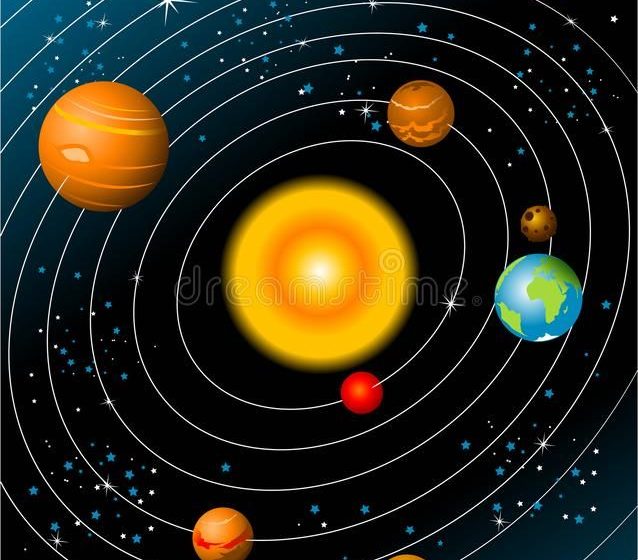

Exploring Our Solar System
The Solar System is a fascinating part of the universe, consisting of the Sun, eight planets, moons, asteroids, comets, and many other objects. It is our cosmic neighborhood and continues to inspire scientists to explore and understand space.
Our solar system is a vast and fascinating neighborhood in space, centered on the Sun. Formed about 4.6 billion years ago from a cloud of gas and dust, it contains eight planets, dwarf planets, moons, asteroids, comets, and countless smaller objects. Although it seems enormous from Earth, the solar system is only a tiny part of the Milky Way galaxy.
The Sun is the heart of the solar system. It is a giant star made mostly of hydrogen and helium, producing light and heat through nuclear fusion. Its gravity holds the entire system together and keeps the planets moving in their paths, called orbits. Without the Sun, life as we know it could not exist.
The four inner planets—Mercury, Venus, Earth, and Mars—are rocky worlds. Mercury is closest to the Sun and experiences extreme temperatures. Venus has a thick, carbon dioxide-rich atmosphere that traps heat, making it the hottest planet. Earth is unique because it has liquid water, breathable air, and conditions that support life. Mars, often called the Red Planet, has fascinated scientists because evidence suggests it once had rivers and lakes.
Beyond Mars lies the asteroid belt, a region containing rocky remnants from the solar system’s early formation. Farther out are the four giant planets: Jupiter, Saturn, Uranus, and Neptune. Jupiter is the largest planet and has a famous storm called the Great Red Spot. Saturn is known for its spectacular ring system, made mainly of ice and rock. Uranus rotates on its side, while Neptune is a cold, windy world far from the Sun.
The solar system also includes dwarf planets such as Pluto, located in the distant Kuiper Belt. Pluto was once considered the ninth planet, but it was reclassified in 2006 because it does not clear other objects from its orbital path. This decision helped scientists better define what makes a planet.
Moons add even more variety to our cosmic neighborhood. Earth has one moon, but some planets have dozens. Jupiter’s moon Europa may contain an ocean beneath its icy surface, while Saturn’s moon Titan has lakes and rivers made of liquid methane. These worlds are important targets in the search for conditions that could support life.
Exploring the solar system helps us understand Earth’s past, present, and future. Robotic spacecraft, telescopes, and planetary missions continue to reveal new discoveries. From the blazing surface of the Sun to the frozen edges beyond Neptune, our solar system reminds us that there is always more to explore.

Comments are closed.
[…] are two major branches of Geography: physical geography and human geography. Both are important for understanding our […]