

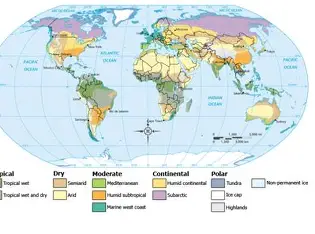

What Are the Causes of the Varied Climates in the World?
The various climates on Earth are due to the fact that the Earth receives and distributes solar energy unevenly. What Are the Causes of the Varied Climates in the World?
There are hot and humid places and cold and dry places. There are areas that get a lot of rainfall the whole year round, and those that may not get rain for entire months.
Climate refers to the average weather of an area over an extended time. Climate is defined by temperature, rainfall, humidity, wind, as well as seasonal patterns. A number of geographic reasons have combined to give rise to the vast differences in climates that exist here on Earth.
What Is Climate?
Climate is the overall weather conditions in a given location over an extended duration of time, commonly decades. It contrasts with weather, which explains the daily situation, like the temperature today, rainfall, or wind. What Are the Causes of the Varied Climates in the World?
An example of the difference between weather and a long-term pattern is a rainy afternoon versus a region with a mainly wet climate.
There are various types of climates on Earth, such as tropical, dry, temperate, continental, and polar climates. Such variations arise due to the fact that different regions of the planet receive different quantities of solar energy, and their physical environments are diverse.
What Is the Relationship between Climate and Latitude?
One of the most crucial factors that regulate climate is latitude.
The planet is not flat, and as a result, sunlight does not reach all parts of the planet at the same angle. Regions close to the Equator get more direct sunlight all year round. Due to this, tropical regions tend to be warmer.
Towards the North and South Poles, the sun is lower in the sky. The same quantity of solar energy is distributed over a larger area, thus these areas become colder.
This is the reason why areas in the tropical regions near the Equator may be hot during most of the year, while polar regions are very cold.
The Role of Sunlight
The climate system of the Earth receives most of its heat through solar energy. A portion of this energy is absorbed by land, water, and the atmosphere, where it gives out heat into the environment.
Latitude and season vary in terms of the amount of sunlight a location receives. What Are the Causes of the Varied Climates in the World? The change of seasons is also brought about by the tilted axis of the Earth.
In summer, one hemisphere will get more direct sunlight and daylight. It gets less direct sunlight and fewer days of sunshine during winter.
This variation is a source of variations in temperatures globally across seasons.
What Is the Impact of Oceans on Climate?
Oceans impact greatly on climate since water warms and cools more slowly than land.
The differences in temperature are also less in coastal regions compared to inland regions. Bodies of water have the capacity to cool nearby areas during hot seasons and warm them during cold seasons.
Heat is also distributed throughout the planet by ocean currents. Cold currents have the potential to cool temperatures along adjacent coastlines, and warm currents have the potential to heat them up.
Moisture is also contributed to the atmosphere by oceans. When the air ascends and cools, this moisture can add to clouds and rainfall.
What Is the Change in Climate with Altitude?
Temperature is also influenced by altitude, or the distance above sea level.
The higher the altitude, the more this air tends to be thin and the colder it gets. That is why mountainous regions can be a lot colder than the adjacent lowlands.
Even a relatively low-latitude city situated at high altitude might experience a cooler climate.
Mountains may also affect rainfall by pushing moist air to rise. The air that ascends cools down and may lead to precipitation on one side of the mountain. The other side can get significantly less rain and end up being fairly dry.
Mountains and Landforms
Topography can have a powerful impact on the climate of a region.
Ranges of mountains may shut or bend winds and influence rain patterns. When damp air gets to a mountain, it can climb the mountain, cool, and fall in the form of rain or snow.
The windward side tends to get more rainfall. A rain shadow might be on the opposite side, where falling air is warmer and drier.
This process has aided in explaining why there may be extremely different climates among some spots that are near one another.
What Is the Impact of Winds on Climate?
Winds transfer heat and moisture between areas. Wind patterns in the world and globally contribute to the distribution of solar energy on the Earth.
As an illustration, warm and moist air in tropical oceans could be transported by winds to other areas. Colder, drier wind can come in on other wind patterns of higher latitudes.
Rain may also be affected by seasonal wind systems. South Asia, for example, has monsoon winds which are significant in supplying seasonal rainfall to Bangladesh, India, and other countries.
Why Do Rainfalls Vary across the Globe?
The distribution of rainfall is not uniform all over the Earth.
Warm and moist air often rises in some parts of the world, and that is why they receive a lot of rainfall. Other areas are dry since the air moves downwards and obstructs the formation of clouds.
Deserts are usually found in regions where rainfall is restricted by atmospheric conditions. The amount of precipitation received by a particular area can also be affected by coastal locations, mountain ranges, ocean currents, and the winds that blow in the area.
Such variations in rainfall influence vegetation, agriculture, water supply, and human settlement.
What Is the Impact of Seasons on Climate?
The tilt of the Earth’s axis is approximately 23.5 degrees. This tilt causes the Earth to receive more or less sunlight in different parts of the world as it goes around the sun.
When one of the hemispheres leans towards the sun, it is in summer. It has winter when it is tilted away.
Temperature variations are less near the Equator. In most northern latitudes, summer and winter may be a lot more different.
How Are There So Many Climate Types?
There is no single aspect that produces all climates. Rather, a number of factors interplay.
The amount of solar energy received in an area depends on its latitude. Altitude influences temperature.What Are the Causes of the Varied Climates in the World? Heat and moisture are carried by the oceans and currents. Mountains influence winds and rainfall. The change of seasons alters sunlight and temperature.
Climate may also be impacted by human activities, especially with the emission of greenhouse gases leading to global warming. Nevertheless, the geographic factors mentioned above, which are natural, contribute to the explanation as to why Earth has varying climatic patterns in the first place.
Conclusion
Several interacting geographic and atmospheric factors have led to the different climates that are experienced in various parts of the world. The climate of any region is affected by latitude, the amount of sunlight, elevation, oceans, ocean currents, winds, mountains, and the seasons of the year.
These climate variations define ecosystems, agricultural practices, water resources, and human colonies. When we learn how climate functions, we can more easily learn why we have hot and rainy conditions in one part of the world and cold and dry conditions in another.
The climate on Earth is an intricate system, and each region possesses its own unique set of geographic conditions which contributes to the uniqueness of its climate.


Comments are closed.
[…] of the Earth’s shape helps us understand various aspects of the Earth and various geographical concepts, namely latitude, longitude, time zones, satellite movement, and […]