


Shape of the Earth: What Is the True Shape of Our Planet?
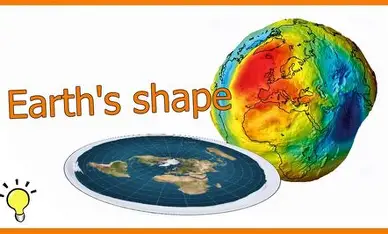
The shape of the Earth is one of the most interesting topics in geography. If you examine photographs of our planet taken from space, the Earth looks almost completely round. But the Earth is not a perfect sphere! Due to rotation, gravity, and the unequal distribution of land and water, its actual shape is slightly different.
Knowledge of the Earth’s shape helps us understand various aspects of the Earth and various geographical concepts, namely latitude, longitude, time zones, satellite movement, and seasons.
Is the Earth a Perfect Sphere?
For many years, the true shape of the Earth was a mystery. Nowadays, there is ample evidence that the Earth is almost spherical. It is, however, not a perfect sphere.
The Earth is slightly rounder at the Equator and slightly flatter at the North and South Poles. Scientists call this an oblate spheroid.
The radius of a perfect sphere would be the same distance from the center to the surface in every direction. In fact, the radius of the Earth at the Equator is a little larger than at the poles.
Though this difference is small, it is significant for scientists who need to make accurate measurements of our planet.
Why Is the Earth Flattened at the Poles?
The Earth’s slightly flattened shape is due to its rotation.
The Earth spins on its axis about every 24 hours. The rotation of the planet causes a centrifugal effect that is greatest near the Equator.
This effect makes Earth’s material bulge slightly around the Equator. Meanwhile, the regions near the poles are slightly flattened.
This causes the Earth to be thicker in the midsection and thinner toward the top and bottom. That is why its overall form is referred to as an oblate spheroid.
What Is an Oblate Spheroid?
Oblate spheroids are shapes that resemble a sphere but are flattened at the poles.
Think about a softball and squeezing the top and bottom. The ball will be slightly broader at its center and taper off toward the ends. The shape of the Earth is similar, but much less pronounced.
Scientists use this term to present Earth’s overall shape more accurately, rather than simply stating that it is a sphere.
But even an oblate spheroid is not an accurate enough description for all the details of the Earth’s surface. The real planet Earth is far more rugged, with mountains, valleys, oceans, and other natural features.
The Earth Is Not Completely Smooth
When we use the phrase “round Earth,” we are referring to the general shape of the Earth. Our Earth’s surface is not even.
Earth is home to huge mountains, ocean trenches, plains, deserts, forests, and valleys. These features result in some minor irregularities in Earth’s surface.
Due to the movement of water under the influence of gravity, the oceans also influence the shape of the Earth. When extremely accurate measurements are required, scientists therefore resort to more advanced models.
An important scientific model is the geoid. It is a mathematical idealization of the shape of the Earth based on gravity and mean sea level. The shape of the geoid is not quite spherical or oblate spheroidal.
How Do Scientists Know the Shape of the Earth?
Scientists have tried to understand Earth’s shape in numerous ways.
The first evidence came from observations of ships. As a vessel heads out to sea, it sinks away from view before the top of its mast. This is due to the curvature of the Earth that the ship passes over.
A second key piece of evidence comes from lunar eclipses. During a lunar eclipse, the Earth is between the Sun and the Moon. The shadow that Earth casts on the Moon is curved. A circular shadow is always observed, and this is evidence of the curved shape of the Earth.
More conclusive evidence comes from modern technology. Scientists can measure the shape and surface of the Earth very accurately using satellites, spacecraft, GPS systems, and Earth-observing instruments.
Photographs taken from space also make it easy to discern the Earth’s curved nature.
Why Is the Shape of the Earth Important?
The shape of the Earth is important in various fields of geography and science.
For instance, Earth’s curved surface affects how we measure distances between places. It is also involved in the calculation of latitudes and longitudes.
The shape of the planet is also related to time zones. The Earth is spherical and rotates on its axis, which means that different regions are exposed to sunlight at different times.
Satellite navigation also has to take the shape of the Earth into account. Accurate location by GPS systems requires correct models of the Earth’s surface.
Knowledge of the shape of the Earth is applied by geographers, engineers, astronomers, and scientists.
Shape and Gravity of the Earth
The shape of the Earth is also important when it comes to gravity. The force of gravity makes matter move toward the Earth’s center. But the effect of this force on the Earth’s surface is influenced by the Earth’s rotation and the distribution of materials in the Earth’s interior.
Earth’s shape is due to gravity and rotation.
Small variations in Earth’s gravitational field also result from the distribution of continents, oceans, mountains, and what lies beneath Earth’s surface. Scientists examine these variations in order to understand more about the outer and inner parts of the Earth.
Conclusion
The shape of the Earth is much more interesting than simply saying that the Earth is round. The planet on which we live is approximately a globe, but due to rotation, it is slightly flattened at the poles and bulging in the middle.
The overall shape of the Earth is termed an oblate spheroid, and the detailed gravitational model is called a geoid.
Knowledge of the shape of the Earth helps us comprehend many geographic components, such as latitude, longitude, time zones, mapping, navigation, and satellite technology. Whether through ancient observations or modern spacecraft, we continue to see just how fascinating all of this is.

Comments are closed.
[…] settlements are places where people live and carry out their activities. A settlement may be a small village, a town, a city, or a large metropolitan […]