


What Are Tectonic Plates? A Basic Introduction to the Sliding Plates of the Earth
What are the plates in the Earth’s crust called? Tectonic plates are chunks of the Earth’s hard crust that move very slowly on the soft material beneath them. The lithosphere (Earth’s crust and uppermost mantle) is formed from these huge rock masses. The Earth’s plates move a few centimeters per year, but they can alter the Earth’s surface over millions of years.
Many of the major geographical features of the Earth are due to tectonic plates. They cause the movement of continents, ocean basins, mountain ranges, and deep ocean trenches. They are also intimately related to earth tremors and volcanic activity.
What Are Tectonic Plates Made Of?
It is best to understand what tectonic plates are understanding the structure of the Earth.
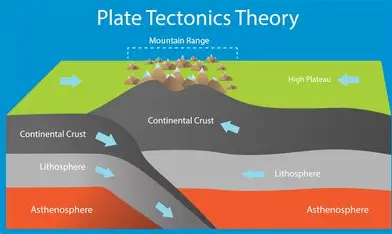
The Earth is divided into various layers. The core is the middle part of the Earth, and the mantle is the outer part. The outermost part is called the crust. The lithosphere is composed of the crust and the hard upper part of the mantle.
The lithosphere is NOT a single plate. Rather, it is subdivided into numerous large and small segments. These sections are called “tectonic plates.”
Slabs of continental crust exist in some plates, but most plates consist largely of oceanic crust. The continental crust is thicker and less dense than the oceanic crust. The oceanic crust is thin and dense.
The plates lie above a warm, weak region of the upper mantle known as the asthenosphere. This enables them to slowly shift over geological time.
How many tectonic plates are there?
There are several large plates and numerous smaller plates recognized by scientists. It is not possible to provide a simple number, due to the variety of ways in which smaller fragments and plate boundaries can be classified.
Some of the major tectonic plates include:
- Pacific Plate
- North American Plate
- South American Plate
- African Plate
- Eurasian Plate
- Antarctic Plate
- Indo-Australian Plate
There are also smaller plates, such as the Nazca Plate, Cocos Plate, Caribbean Plate, Arabian Plate, and Philippine Sea Plate.
These plates together wrap around almost the entire Earth.
In what layer of the Earth are tectonic plates found?
Tectonic plates are found beneath both continents and oceans. They are not the same thing as continents.
The North American Plate contains most of North America and some of the bottom of the Atlantic Ocean. In a similar fashion, the Pacific Plate extends primarily under the Pacific Ocean.
This means that a tectonic plate may have both land and sea on it.
Plate boundaries are frequently under oceans, in mountains, or in areas of faults. These areas are zones of much of the geologic activity of the Earth.
The speed of tectonic plate motion.
The tectonic plates are very slow in their movements. Their rate of migration is, in many places, only a few centimeters per year.
It sounds like a small amount, but in geologic terms, it is a very long time. The motion of a few centimeters per year can amount to hundreds of kilometers per million years.
The direction and rate of motion depend on the type of plate. Some plates slide toward one another, some plates move away from each other, and some plates slide sideways.
The movement of plates is very slow, and generally people are not able to feel it. The impacts, however, may be manifested in geological processes that take much longer.
At tectonic plate boundaries, what happens?
Along plate boundaries, tectonic plates interact primarily. There are three basic types of plate boundaries.
Divergent Boundaries
Divergent boundaries are places where plates are moving away from each other.
When the plates move apart, mantle material can flow up and cool to form new crust. This is particularly prevalent along underwater ridges.
A mid-ocean ridge is an example of a large divergent boundary.
Convergent Boundaries
Convergent boundaries occur where two plates converge or move toward each other.
When an oceanic plate collides with another plate, the heavier oceanic plate can slip underneath the other plate. This is known as subduction.
Two continental plates can converge, causing compression and uplifting of the crust. Such movements have helped to create important mountain ranges.
Transform Boundaries
Transform boundaries are places where plates move past each other in a sideways direction.
Friction can cause stress to build up along faults. Rocks can suddenly move, releasing energy that can cause an earthquake.
A famous example of a transform fault is the San Andreas Fault in California.
What is the influence of tectonic plates on the Earth’s surface?
On the whole, the Earth’s surface is continually reshape tectonic plates.
Their movement can form and erode portions of the crust. They also help to shape mountainous areas, ocean trenches, volcanic areas, and earthquake zones.
For instance, plates can meet and fold or raise the Earth’s surface. When plates break apart, new crust can grow. Earthquakes develop when two plates pass by each other.
All of these processes can, over millions of years, alter the landscape of an area entirely.
The Earth’s surface is divided into plates where the continents lie.
The continents were not necessarily in the same locations as they are now.
Many of the world’s continents were once part of a much larger landmass known as Pangaea, and scientists have discovered evidence of this. Over geological time, the continents drifted away from one another—the tectonic plates had moved.
This is referred to as continental drift. The general explanation for the movement of continents over geologic time is modern plate tectonics.
The shapes of continents, similar rocks, fossils discovered on various continents, and other geological evidence all help scientists understand this long history.
The significance of tectonic plates.
Knowledge of tectonic plates enables scientists to gain an understanding of how the Earth changes over time.
Many significant geographical features and geological events can account for plate movements. They also assist researchers in determining areas where earthquakes and volcanic activity occur.
Knowing the plate boundaries is especially helpful when investigating natural hazards. Geological activity can monitor, and information on plate activity can use help assess hazards associated with earthquakes and volcanoes.
Conclusion
Tectonic plates are vast blocks of the solid Earth that slide around over geologic periods. These may include landmasses, seabeds, or both. Though it is very slow, their motion has deep impacts on the planet.
Major features of the Earth’s surface, such as mountains and ocean basins, earthquakes, and volcanoes, are the result of interactions between tectonic plates. The analysis of these mobile plates gives researchers a better insight into the history of their planet as well as the geological activity that has been occurring on our planet.

Comments are closed.
[…] from place to place on Earth. It also has significant importance in weather and climate. Water movement is relating rainfall, snowfall, clouds, humidity, and many other atmospheric […]