


What Are Plate Tectonics?
What Are Plate Tectonics? : How do Earth’s plates move?
Plate tectonics is the theory stating that large portions of the Earth’s outer layer move slowly over time. These moving sections are referred to as tectonic plates. They make up the Earth’s continents and ocean floors and interact with each other in ways that can cause earthquakes, volcanoes, deep ocean trenches, and mountains to form.
Though very slow, the movement of plates cause the formation of most of the Earth’s surface over millions of years. Plate tectonics is also the basis for explaining the distribution of continents today and the concentration of earthquakes and volcanoes in certain areas.
What Are Tectonic Plates?
Earth is made up of several layers. The outermost solid layer is called the crust. The upper portion of the mantle lies under the crust. The crust and the top part of the mantle make up the lithosphere.
The lithosphere is broken into large pieces called tectonic plates. Some plates consist primarily of oceanic crust, and some plates consist of continental crust plus oceanic crust.
The major plates are the Pacific Plate, North American Plate, South American Plate, African Plate, Eurasian Plate, Antarctic Plate, and Indo-Australian Plate. There are also numerous small plates.
These plates interact a bit like a large puzzle, except that they are always in motion.
What Is the Movement of the Plates on Earth?
An important question that arises is: How do Earth’s plates move?
The movement of the tectonic plates is causing processes within the Earth’s interior. The mantle warms up due to heat from the interior of the Earth, causing slow convection currents within the mantle. Researchers have identified various forces that could cause plates to move.
The heat of the material rising and the cooling of the material sinking in the mantle is one process. These movements can cause the movement of plates above them.
The other one is an important force known as slab pull. As a dense oceanic plate descends into the mantle at a subduction zone, it can drag the rest of the plate along.
An associated process is called ridge push. Hot material rises and new oceanic crust forms at underwater mid-ocean ridge regions. This ridge is able to push the surrounding plate away.
The speed of plate movement is very low compared to the speed of motion encounter us in our daily activities. The motion of most plates is only a few centimeters per year. But this slight motion can, over millions of years, cause great changes.
What Happens When Tectonic Plates Meet?
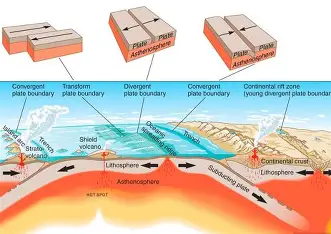
The zone at which tectonic plates interacting is known as plate boundaries. They fall into three categories: divergent, convergent, and transform boundaries.
Divergent Plate Boundaries
A divergent boundary is where two plates diverge.
Magma from below can rise between the plates, cooling to become new crust. Most frequently, it takes place along mid-ocean ridges.
A prominent example is the Mid-Atlantic Ridge. It passes through the Atlantic Ocean, where it helps to widen the ocean basin.
Convergent Plate Boundaries
A convergent boundary is where two plates are sliding toward each other.
When an oceanic plate collides with another plate, it can descend below the other plate. This is known as subduction.
Deep ocean trenches, earthquakes, and volcanoes can form as a result of subduction. If two continental plates collide, neither will sink easily into the mantle. The crust can instead buckle and rise and create large mountain ranges instead.
The Himalayas are a result of the Indian Plate colliding with the Eurasian Plate.
Transform Plate Boundaries
A transform boundary is where two plates slide past each other horizontally.
This movement can generate friction and allow stress to accumulate along the faults. Once that stress is release, an earthquake can result.
A well-known example of a transform plate boundary is the San Andreas Fault in California.
How Are Mountains Formed by Plate Tectonics?
Plate tectonics is a significant factor in the formation of mountains.
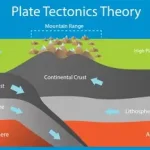
During continental collision, the Earth’s crust may compress and folded. This process, over millions of years, can raise large masses of land.
The Indian and Eurasian plates are still moving, causing some of the Himalayas to be affected. This indicates that mountain building is not necessarily an ancient phenomenon. The surface of Earth can still change today!
How Is Plate Tectonics Responsible for Earthquakes?
Plate movement is closely related to earthquakes. Tectonic plates in motion may generate stress in faults and plate boundaries.
On some faults, the rocks move suddenly on opposite sides of the fault. The stored energy is then released as seismic waves, causing an earthquake.
Many earthquakes are located at plate boundaries, but earthquakes also happen inside plates.
This is the reason for more earthquakes occurring in regions close to active plate boundaries than in many other regions.
What Causes Volcanoes in Plate Tectonics?
Volcanic activity, too, is closely related to plate tectonics.
At some convergent boundaries, an oceanic plate subducts under another plate. The water and/or other fluids introduced into the mantle can help magma to form. This magma can eventually make its way toward the surface and make volcanoes.
Volcanoes may also form at divergent boundaries, where plates move apart and magma escapes through cracks in the Earth’s crust.
There are also some volcanoes away from plate boundaries due to hotspots in the mantle.
Why Is Plate Tectonics Important?
The plate tectonics theory helps explain many large-scale features and processes of the Earth. It can use describe the distribution of mid-ocean ridges, volcanoes, earthquakes, and ocean trenches.
The theory also accounts for the movement of continents with time.
The continents of Earth were much different millions of years ago. They slowly continue to change the shape of the Earth.
Conclusion
What does “plate tectonics” mean? It is the theory that the rigid outer layer of the Earth is broken into large plates of land which move slowly over geological time. At the boundaries of these plates, they interact with each other: they slide apart, they collide, or they move past each other.
Plate movement occurs at a slow rate (a few centimeters per year); however, the impact of plate movement over millions of years is significant. One of the key ideas to help explain how the Earth changes are plate tectonics, which helps explain how mountains, earthquakes, volcanoes, and ocean basins form.

Comments are closed.
[…] of the major geographical features of the Earth are due to tectonic plates. They cause the movement of continents, ocean basins, mountain ranges, and deep ocean trenches. They are also intimately […]