


What Are Rocks?Types of Rocks Explained
Rocks are natural solid materials that make up much of the Earth’s surface and interior. What Are Rocks? Types of Rocks Explained They can be found almost everywhere,
from the highest mountains and deserts to the bottoms of oceans. Rocks come in many different shapes, sizes, colors, textures, and compositions.
Some rocks are hard and dark, while others may be light-colored, soft, or made of visible layers. Although rocks may look simply, they contain important clues about the history and structure of our planet.
Rocks are also important sources of minerals and natural resources that people use every day. Geologists study rocks to understand how they formed, how they changed, and what they can tell us about Earth’s history.
What Are the Three Types of Rocks?
There are three main types of rocks:
- Igneous rocks
- Sedimentary rocks
- Metamorphic rocks
These three groups are connected through a natural process called the rock cycle. Over millions of years, rocks can be broken down, buried, heated, compressed, melted, or cooled and eventually become different types of rocks.
What Are Igneous Rocks?
Igneous rocks form when molten rock cools and becomes solid. Molten rock beneath Earth’s surface is called magma, while molten rock that reaches the surface is called lava.
The speed and location of cooling affect the appearance and texture of an igneous rock.
When magma cools slowly beneath Earth’s surface, large crystals can develop. Granite is a common example of an igneous rock that forms underground.
When lava cools quickly at Earth’s surface, the crystals are usually much smaller. Basalt is a common volcanic igneous rock formed in this way.
Examples of igneous rocks include:
- Granite
- Basalt
- Obsidian
- Pumice
Igneous rocks can therefore form both beneath Earth’s surface and at the surface during volcanic activity.
What Are Sedimentary Rocks?
Sedimentary rocks form from sediments that accumulate, become compacted, and eventually cement together.
Sediments can come from fragments of older rocks, minerals, plant remains, and other materials. Rivers, wind, glaciers, waves, and rain can transport these materials from one location to another.
Over time, layers of sediment may build up. The weight of material above can put pressure on the lower layers, causing them to become compacted. Minerals dissolved in water can also act as natural cement, joining the particles together.
Common examples of sedimentary rocks include:
- Sandstone
- Limestone
- Shale
- Conglomerate
Sedimentary rocks are especially important to scientists because they can contain fossils. Fossils provide evidence about ancient plants, animals, and environments.
For example, a layer of sedimentary rock containing marine fossils may provide evidence that an area was once covered by an ancient sea.
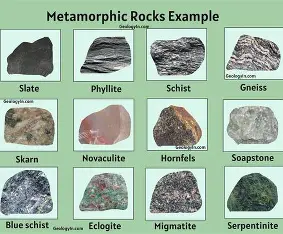
What Are Metamorphic Rocks?
Metamorphic rocks form when existing rocks are changed by heat, pressure, or chemically active fluids without completely melting.
The original rock, known as the parent rock, can be igneous, sedimentary, or another metamorphic rock.
For example, limestone can change into marble when exposed to suitable heat and pressure. Similarly, shale can change into slate.
Metamorphic rocks can develop new minerals, textures, and structures as conditions deep inside Earth’s crust change.
Examples of metamorphic rocks include:
- Marble
- Slate
- Gneiss
- Quartzite
These rocks provide evidence of the powerful geological forces that operate beneath Earth’s surface.
What Is the Rock Cycle?
The rock cycle describes how rocks can change from one type to another through different geological processes.
For example, an igneous rock exposed at Earth’s surface can be broken down by weathering and erosion. The resulting sediments may be transported and deposited elsewhere. Over time, compaction and cementation can turn these sediments into sedimentary rock.
If a rock becomes buried deep underground, increasing heat and pressure can transform it into a metamorphic rock.
If rocks become hot enough to melt, they can form magma. When the magma cools and crystallizes, it can form a new igneous rock.
The rock cycle does not follow only one direction. Any type of rock can potentially change into another type through different geological processes.
Why Are Rocks Important?
Rocks are important to both nature and human society.
They form the foundations of many mountains, cliffs, valleys, and other landforms. When rocks break down through weathering, they can contribute to the formation of soil, which supports plant life.
Rocks and the minerals within them are also valuable natural resources. Materials such as iron, copper, gold, limestone, and other minerals are obtained from geological deposits.
Many rocks are also used as construction materials. Stone, gravel, limestone, and other geological materials are used to build roads, houses, bridges, and other structures.
How Do Rocks Help Us Understand Earth’s History?
Rocks contain valuable evidence about Earth’s past.
Their minerals, structures, layers, and locations can provide clues about ancient environments and geological events. Sedimentary rocks may contain fossils that reveal what kinds of organisms lived in an area millions of years ago.
Other rocks can preserve evidence of volcanic eruptions, mountain building, changes in climate, and movements of tectonic plates.
By studying these clues, geologists can reconstruct parts of Earth’s long and complex history.
Where Can Rocks Be Found?
Rocks are found almost everywhere on Earth.
Large rock formations can be seen in mountain ranges, while smaller rocks and sediments are commonly carried by rivers and streams. Beaches may contain sand, pebbles, and rounded stones that have been shaped by weathering and erosion.
Deserts can contain large rock formations that have been gradually shaped by wind and other forces.
Rocks also exist beneath the oceans and deep below Earth’s surface, even when they cannot be seen directly.
Conclusion
Rocks are much more than ordinary pieces of solid material. They are an important part of Earth and provide evidence about the planet’s formation and history.
The three main types of rocks are igneous, sedimentary, and metamorphic. Each type forms in a different way, but all three are connected through the rock cycle.
Over millions of years, rocks can be changed by weathering, erosion, heat, pressure, melting, and cooling. By studying rocks, scientists can learn about Earth’s structure, natural resources, ancient environments, and the geological events that shaped our planet.
In many ways, rocks are like a record of Earth’s past. Their layers, minerals, fossils, and structures tell the story of a planet that has been changing for billions of years.

Comments are closed.
[…] are extremely important in nature and in human life. They contribute to rock formation and geological processes and are used in numerous products for houses, electronics, cars, tools, and […]