


What are minerals, and why are they important?
What are minerals? Minerals are naturally occurring, inorganic substances with a definite chemical composition and an orderly internal structure. They are crucial components of rocks and occur all across the Earth’s crust.
Sometimes believed to be very simple substances, are extremely important in nature and in human life. They contribute to rock formation and geological processes and are used in numerous products for houses, electronics, cars, tools, and more.
Earth is home to thousands. Each has its own physical and chemical properties that help researchers identify and group them.
What causes minerals to form?
There are various ways in which may developer naturally in the rocks. Some are former the cooling and solidification of molten rock. Others form when water evaporates, leaving deposits of dissolved substances.
Minerals can also form when rocks are deep within Earth’s crust, where they are subjected to heat, pressure, or chemical alteration.
like quartz and feldspar can crystallize as the magma cools. The salt minerals are left behind when salty water evaporates.
Size, shape, color, and other properties may influence the conditions in which they are formed.
What characteristics do minerals have?
There are several physical properties use scientists for identification.
Color
Color is an easily observed property but not always reliable, as the same mineral can have different colors as a result of impurities.
Hardness
Hardness is related to a mineral’s ability to resist scratching. Scientists use the Mohs scale to describe the hardness of ranging between 1 and 10.
The hardness of talc is 1, and that of diamond is 10, which is the highest hardness value among naturally occurring.
Luster
Luster refers to the way that a mineral reflects light. The appearance
can be metallic, glassy, pearly, or dull.
Streak
Streak is the color of the powder of a mineral. It is at times a better clue for identification than the surface color.
Crystal Shape
Many minerals have characteristic crystal forms. Their shapes correspond to an atom’s internal structure within the mineral.
Minerals come in many different types. There are numerous kinds of
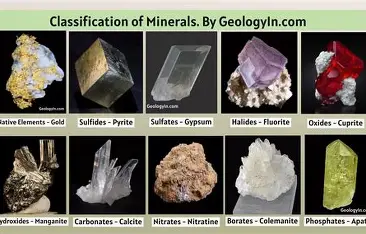
There are various ways in which minerals can be classified based on their chemical compositions.
The most common groups are the silicates, carbonates, oxides, sulfides, and halides.
Silicate minerals are particularly abundant, since they consist of silicon and oxygen, two of the most abundant elements in Earth’s crust.
Quartz is a common silicate mineral. Another major group occurring in many rocks is called feldspar.
Carbonates include minerals such as calcite, which is an important component of limestone.
Minerals and Rocks
Although closely related, rocks and different.
A mineral is a naturally occurring in the Earth formed with the same chemical composition and crystal structure. A rock is a natural solid that typically consists of one or more.
For instance, quartz, feldspar, and mica often occur in granite.
This means that many rocks on Earth are composed of some
In what ways are minerals important?
Minerals are vital to the environment and to society today.
Many minerals are ‘virgin’ raw for production. Mineral-rich ores provide metals like iron, copper, aluminum, and zinc.
Iron is required to make steel for the construction of buildings, bridges, vehicles, and machinery. Copper is also used in electrical wiring, as it is an efficient conductor.
Other minerals use for glass, ceramics, cement, fertilizers, paints, and various industrial items.
Minerals are essential to everyday life. Everyday life requires.
Products containing are probably used on a daily basis without any awareness.
from Earth’s resources are use make mobile phones, computers, cars, batteries, household appliances, and electrical equipment.
Minerals are also used as construction material. Limestone is a significant material for the making of cement and materials based on for concrete and glass.
Some cosmetics, medicines, and personal care products may contain-based ingredients.
Minerals and Agriculture
Another important function is in agriculture.
Plants require some kind of nutrients to grow. This includes macronutrients like phosphorus, potassium, calcium, magnesium, and sulfur that are essential for plant growth.
Certain are uses produce fertilizers to replenish soil nutrients used in agriculture.
Soils are a blend of organic matter, water, air, and living organisms. Hence, minerals are a vital component of natural systems that underlie food production.
From Where Do Minerals Come?
Minerals are found in the rocks of the Earth’s crust. Some of them discovers near the surface, and others are located underground.
Geologists examine rocks and rock formations to identify areas that may contain valuable resources.
Then mining can take place to remove and ores from the land. But mining has the potential to impact landscapes, water, wildlife, and people.
Therefore, when accessing resources, it is important to take sustainable resource management and environmental protection into account.
Minerals and the history of the Earth.
Minerals can also offer valuable insights into Earth’s past.
By analyzing in rocks, scientists are able to gain insights into how and when rocks formed. Evidence of ancient geological conditions is preserved in some.
Specific can also enable scientists to study volcanic activity, tectonic activity, and events that occurred deep within Earth’s crust.
An added benefit is that they can serve as valuable records of the geological history of Earth
Conclusion
Minerals are naturally occurring inorganic substances that have definite chemical composition and an organized internal structure. They form an integral part of many rocks and play a significant role in Earth’s geological processes.
Minerals are also important in today’s life. They are use as raw materials in construction, technology, transportation, agriculture, manufacturing, and other products used in daily life. While a lot might seem like just ordinary rock, they are vital to Earth and our lives

Comments are closed.
[…] of plates cause the formation of most of the Earth’s surface over millions of years. Plate tectonics is also the basis for explaining the distribution of continents today and the concentration of […]