


What Causes Thunderstorms?
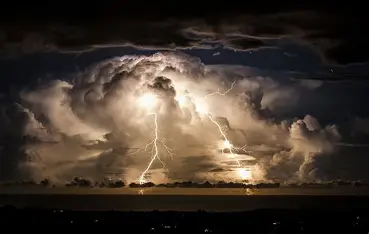
What causes thunderstorms? Thunderstorms form when warm, moist air rises into the atmosphere and creates powerful clouds. As the air rises and cools, water vapor condenses into tiny droplets and ice particles. Strong air movements inside these clouds can produce heavy rain, lightning, thunder, and strong winds.
What Causes Thunderstorms to Form?
Thunderstorm: When thunder and lightning are observed. Most thunderstorms will also include rain, though some thunderstorms can result in very little rain on the ground.
Cumulus nimbus clouds are big clouds where thunderstorms develop. Large upward and downward air currents can be present in these clouds,
and they may extend to several kilometers in height.
To form a thunderstorm, typically three ingredients are required:
Warm air
Moisture
Rising air
Thunderstorms can develop when all these conditions combine.
How are thunderstorms formed?
The sun warms the Earth’s surface, where the process starts. When the ground is warm, the air near the ground is warm. This warm air is lighter and will start to rise.
The water vapor cools as it ascends in the atmosphere, if there is sufficient moisture to start with. The vapor becomes liquid water droplets or ice particles. These particles do create clouds.
Warm moist air keeps rising, and the cloud keeps developing and grows taller and larger. It can grow up to become a cumulonimbus cloud. What causes thunderstorms?
Within this cloud strong air currents are flowing upwards and downwards. These movements contribute to a thunderstorm’s development.
How and why are lightning strikes happening?
Among the most spectacular features of a thunderstorm is its lighting. It is a massive electrical shock that occurs due to the accumulation of electric charges within a storm cloud.
Water droplets, ice crystals, and ice fragments are colliding within the interior of the developing thunderstorm. The collisions separate electrical charges.
Typically, positive will accumulate in the upper portion of the cloud, and negative will accumulate in the lower portion. If this difference in charge is great enough, electricity can leap through the air.
When this electric discharge happens, lightning is produced.
Lightning can happen within a cloud, between clouds and between a cloud and the ground.
What Causes Thunder?
Thunder is the loud sound produced by lightning.
When lightning produces its way throughout the ambiance, it warms the air very rapidly. The air suddenly expands and forms a strong shock wave. This shock wave is heard as thunder.
Lightning is seen before thunder is heard because light can travel very quickly compared to sound.What causes thunderstorms?
One way to estimate the distance to a lightning strike is to count off the seconds that pass between the flash and the sound. The greater the delay, the greater the distance of the lightning.
How and Why Thunderstorms Bring a lot of rain?
Large quantities of water vapor build up in the clouds of thunderstorms, which can cause heavy rain to fall.
Water vapor is transported up to the higher altitudes with the rising of the warm air. At higher altitudes, the vapor cools and clumps together into droplets or ice particles. As they collide and combine, these particles get bigger.
Once they get too heavy and big, they fall towards the ground as rain.
Very heavy rainfall over a short time can result from strong thunderstorms. This can lead to waterlogging or flash flooding in low areas.
Why do strong winds occur in a thunderstorm?
The other factor that is common in thunderstorms is strong winds.
Cooling of air in a storm cloud can cause the air to flow quickly downward. Once this air gets to the bottom, it blows outwards and generates powerful winds.
The movements within the cloud can also make the atmosphere turbulent due to the rising and falling in the cloud. Therefore, the wind occasionally may increase and decrease in speed and shift in direction during a storm.
In severe thunderstorms, sometimes damaging wind gusts are generated.
Does thunderstorm hailfall occur?
Yes. Thunderstorms may have hail.
Strong updrafts in a thunderstorm lift water droplets in the air to high altitudes, where they freeze to hail. The droplets freeze and can maybe pick up more layers of ice as they travel through the cloud.
When the ice particle grows too large, and the rising air current is no longer able to hold it up, the hailstone falls toward the ground.
Strong thunderstorms that have strong updrafts are more likely to produce hail.
Where are thunderstorms found?
Thunderstorms are possible in numerous regions of the world. They are more prevalent in warm and humid regions since these regions are those where the heat and moisture are available for storm development.
Thunderstorms can occur over both land and water. They can also occur at other times when the conditions in the atmosphere are right, although they tend to occur during warm afternoons when the ground is strongly heated.
Are Thunderstorms Dangerous?
While most thunderstorms will do no serious harm, strong thunderstorms can be dangerous.
Lightning can injure persons and cause fires. The heavy rains can lead to flooding, and the high winds can bring down trees, buildings, and power lines. Severe thunderstorms may also include hail or tornados.
Stay out of the open areas and inside during a thunderstorm. Similarly, one should avoid exposure to solitary trees, water, and bare metal structures.
Final Thoughts
Thunderstorms form from a variety of complex atmospheric conditions related to heat, moisture, and rising air. Warm, moist air is rising, and this contributes to the development of large CBS. Within these clouds, strong air currents and electric charges generate lightning, thunder, heavy rain, and occasionally hail.
Knowing how thunderstorms develop appreciates the science of thunderstorms. Thunderstorms may be spectacular to observe and fascinating to study, but they can also be deadly, so it is wise to take precautions when storms are nearby.


Comments are closed.
[…] form of very small water drops in the moist air near the earth’s surface due to a decrease in temperature. Such droplets stay close to the ground, forming a cloud at the earth’s surface. Fog may […]