

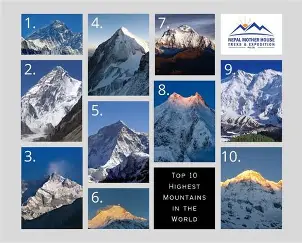

Highest Mountains in the World: Top 10 Majestic Peaks
The highest mountains in the world attract climbers, travelers, photographers, and nature lovers from every corner of the planet. These giant peaks rise thousands of meters above sea level and create some of the most dramatic landscapes on Earth. Most of the world’s tallest mountains stand in the Himalayas and the Karakoram ranges of Asia.
These mountains do more than create beautiful scenery. Their glaciers store freshwater, their valleys support unique ecosystems, and their landscapes hold deep cultural importance for nearby communities. Here are the top 10 highest mountains in the world, ranked by elevation above sea level.
1. Mount Everest – 8,848.86 Meters
Mount Everest holds the title of the highest mountain in the world, reaching 8,848.86 meters above sea level. The mountain stands along the border between Nepal and China in the Himalayas.
Nepal calls Everest Sagarmatha, while Tibetans call it Oolemma. Climbers from around the world dream of reaching its summit, but extreme cold, strong winds, thin air, and sudden weather changes make the journey extremely challenging.
2. K2 – 8,611 Meters
K2 rises to 8,611 meters in the Karakoram Range along the Pakistan-China border. It ranks second among the highest mountains in the world.
Many climbers consider K2 more difficult than Everest because of its steep slopes, unpredictable weather, and technical climbing routes. The mountain’s dramatic shape makes it one of the most impressive peaks on Earth.
3. Kangchenjunga – 8,586 Meters
Kangchenjunga reaches 8,586 meters and stands along the border between Nepal and India. It ranks third among the world’s tallest mountains.
The mountain features several major peaks and massive glaciers. Local communities consider Kangchenjunga a sacred mountain, and its surrounding region contains diverse plants and wildlife.
4. Lhotse – 8,516 Meters
Lhotse rises to 8,516 meters beside Mount Everest. The South Col connects the two mountains, and climbers often encounter similar high-altitude conditions on both peaks.
Lhotse features an impressive, steep face that challenges experienced mountaineers. Its name means “South Peak” in the Tibetan language.
5. Makalu – 8,485 Meters
Makalu reaches 8,485 meters in the Himalayas of Nepal near the Chinese border. Its distinctive four-sided pyramid shape makes it easy to recognize.
The mountain offers challenging climbing routes because of its steep ridges and sharp edges. The surrounding Makalu-Barun region also contains beautiful valleys, forests, glaciers, and rich biodiversity.
6. Cho – 8,188 Meters
Cho Oyu stands 8,188 meters high near the Nepal-China border. It ranks sixth among the highest mountains in the world.
Compared with some other 8,000-meter peaks, Cho has several routes that climbers consider more accessible. However, extreme altitude and harsh weather still create serious risks.
7. Dhaulagiri I – 8,167 Meters
Dhaulagiri, I reach 8,167 meters in north-central Nepal. Its name comes from Sanskrit and means “White Mountain.”
The peak dominates the surrounding landscape with its snow-covered slopes and dramatic ridges. The Dhaulagiri region also attracts trekkers who want to experience remote Himalayan scenery.
8. Manaslu – 8,163 Meters
Manaslu rises to 8,163 meters in Nepal and ranks eighth among the world’s highest mountains. The name “Manaslu” comes from a Sanskrit word associated with the spirit or intellect.
The mountain attracts climbers with its challenging routes and spectacular surroundings. Nearby villages and trekking trails offer visitors a closer look at Himalayan landscapes and local culture.
9. Nanga Parbat – 8,126 Meters
Nanga Parbat reaches 8,126 meters in Pakistan’s Gilgit-Baltistan region. People often call it the “Killer Mountain” because of its difficult climbing history.
The mountain features enormous cliffs, steep slopes, and dramatic valleys. It’s beautiful scenery attracts adventurous climbers and trekkers from around the world.
10. Annapurna I – 8,091 Meters
Annapurna, I rise to 8,091 meters in north-central Nepal. It ranks tenth among the highest mountains in the world.
The Annapurna region remains one of Nepal’s most popular trekking destinations. Travelers can enjoy mountain views, traditional villages, forests, rivers, and diverse landscapes throughout the region.
Why Are the Highest Mountains in the World Important?
The world’s tallest peaks play an important role in nature and human life. Snow and glaciers on these mountains feed rivers that provide water to millions of people across Asia. Highest mountain in the world
Mountain ecosystems also support rare plants and animals. In addition, the Himalayas and Karakoram hold great cultural and spiritual importance for many communities.
These mountains also support tourism. Trekking and mountaineering bring visitors to remote areas and provide income for local communities.
Challenges of Climbing the Tallest Mountains
Climbing an extremely high mountains requires careful preparation. At great elevations, the air contains much less oxygen, which makes breathing difficult. Climbers also face freezing temperatures, powerful winds, avalanches, falling rocks, and rapidly changing weather.
Experienced mountaineers use specialized equipment, careful route planning, and acclimatization to deal with these conditions. Even with preparation, high-altitude climbing remains dangerous.
Final Thoughts
The highest mountains in the world represent some of Earth’s most spectacular natural wonders. From Mount Everest to Annapurna I, each peak has its own landscape, history, culture, and challenges.
These mountains remind us of the incredible forces that shape our planet. Protecting their glaciers, wildlife, and surrounding ecosystems will help preserve these remarkable landscapes for future generations.

Other Articles


One Comment
Comments are closed.
[…] formation of can take hundreds or even thousands of years. Climate, rocks, plants, animals, landforms, and time all influence how develops. Because forms so slowly, protecting it is […]