


Geography and Where People Live: How Geography Shapes Human Settlement
The environment where people live and geography have a strong relationship. The physical characteristics of Earth affect the location of settlements, the way of life of people, and the expansion of their settlements. Individuals have not selected locations to live in at random. Water, climate, landforms, soil, natural resources, mode of transportation, and employment facilities are all factors that greatly influence human settlements. From big urban areas along riverbanks to agricultural societies on fertile plains, geography gives us an idea of why people are where they are. Knowing this relationship also helps us understand how various regions of the world grow and develop.
Why Water Matters to Human Settlement
One of the most significant determinants of where people live is water. Water is required by people to drink, farm, cook, and for industry and various other everyday activities.
There are numerous examples of big civilizations that existed along rivers. The rivers supplied fresh water and assisted farmers in producing crops. They also developed transport channels that linked various communities.
Even in the present day, there are numerous large cities that exist along rivers, lakes, or shorelines. Fishing, trade, tourism, and transportation can also be supported in coastal areas.
As an illustration, the Nile River has been significant in the establishment of settlements in Egypt. Likewise, the Ganges-Brahmaputra River system sustains the lives of millions in South Asia.
What Is the Relationship between Climate and the Living Place?
Human settlement is greatly affected by climate. Moderate climates usually make life easier, as people can engage in agriculture, construction, and daily routines. Permanent settlement can be made harder by very hot environments, very cold environments, or very dry environments.
An example of this is deserts, which receive minimal amounts of rainfall.where people live and geography This leads to the clustering of population around water resources like rivers, oases, and irrigated agricultural lands.
Conversely, regions with appropriate temperatures and constant rainfall are able to support agriculture and increased populations. Nevertheless, current technology has enabled individuals to survive well in most hostile environments.
The climate also determines the kind of houses that people construct, the attire that people wear, the crops that people cultivate, and the activities that people engage in.
Landforms Role
Another significant aspect of geography and the location of human habitation is landforms. Different living conditions arise due to the mountains, plains, valleys, plateaus, and coastal regions.
The flat plains tend to be favorable for settlement since they are simple to construct on and can be used to practice large-scale farming. Numerous highly populated parts of the world are found on rich plains.
Transport and building can be a challenge due to the steep slopes and rough terrain of the mountains. Thus, the distribution of populations is usually clustered in valleys and flattened regions in mountainous regions.
Coastal areas are also prone to accommodating huge populations due to access to ports, fishing areas, trade routes, and tourism.
What Is the Impact of Soil on Population Distribution?
One cannot always see soil in real life; however, it is a significant aspect of human geography. Due to fertile soil, farmers can easily produce food to sustain more people.
Settlements tend to be based in agricultural zones that have fertile soils due to their food production and job opportunities. With time, villages may evolve to become towns and cities as the populations grow.
Rivers have special significance in fertile lands since they can deposit sediments on the surrounding land that are rich in nutrients. This is capable of forming viable agricultural lands.
Natural Resources and Human Settlements
Natural resources also determine the place of residence. Materials like coal, oil, natural gas, minerals, forests, and fertile land have the ability to generate economic opportunities.
When the area has valuable resources, businesses and workers can migrate. Resource-based industries can then develop new roads, housing, schools, and other facilities.
Nevertheless, the availability of resources does not necessarily translate into high populations. Settlement patterns can be influenced by other factors such as climate, transportation, government policies, and economic conditions.
Employment and Economic Opportunity
One of the most powerful factors that determine the place of residence in the modern world is employment. The movement of people to places where they are able to get improved jobs, education, health care, etc., is common.
Big cities are attractive, as they typically have a variety of industries and services. Employment can be created in technology, manufacturing, finance, education, healthcare, tourism, and transportation.
This is among the reasons why the urban population has increased very fast in most areas of the world. With the development of cities, the surrounding territories also may get more densely populated.
Transportation and Accessibility
Transportation enhances ease of access for individuals and companies to other destinations. Settlement can thus be affected by roads, railways, airports, and ports.
Good transport infrastructure usually attracts business and residents in places with good transportation networks, since individuals are able to travel with ease and goods can move efficiently.
Trade routes, rivers, and major roads have been known to form the basis of many towns historically. In current times,where people live and geography big cities still develop in the areas of transportation hubs like airports, railway stations, highways, and seaports.
Why Is It That There Are More People in Some Places Than in Others?
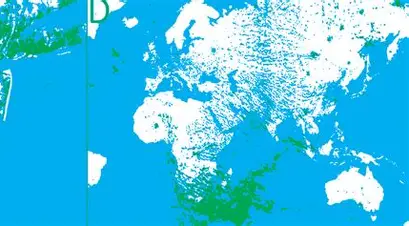
The world’s population is not distributed evenly. Few regions have few permanent inhabitants, and others have millions of people living close to each other.
Population density is based on a physical-human combination. Population can be stimulated by fertile land, water, moderate climates, transportation, employment, and infrastructure.
In the meantime, more adverse environments such as extreme deserts, polar areas, highlands, and other regions with challenging environmental factors are more likely to have lower population levels.
Nevertheless, it is not just a matter of geography. Technology enables individuals to adjust to other environments that once were challenging to live in. The location of population concentration is also influenced by economic development, government choices, culture, and past experience.
Geography Keeps Influencing the Life of Humans
Technology is altering the world, and geography and the location of people are still closely related. Modern transportation, heating, air conditioning, irrigation, and engineering methods can help people overcome most of the environmental challenges. However, geography still plays a role in settlement, agriculture, transport, and economics.
Through geography, I get to learn why cities tend to develop in specific locations, why people tend to migrate or even relocate to other regions, and why certain regions tend to have much higher population density compared to others.
Finally, the location of people is the outcome of natural decisions and the environment. The human landscape is the result of interactions between water, climate, landforms, soil, resources, jobs, transportation, and infrastructure.



Comments are closed.
[…] migration refers to a concept in which people leave one place and go to another with the aim of staying either temporarily or […]