

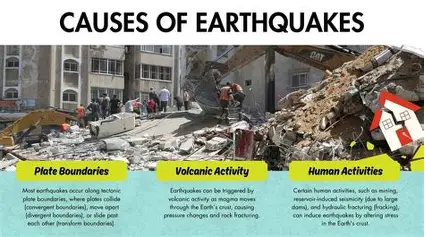

What Causes Earthquakes? What is an Earthquake?
Among the most powerful of Earth’s natural phenomena are earthquakes. Many people ask, “What causes earthquakes?” when the ground suddenly shakes beneath our feet. An earthquake is the release of energy that is stored in the Earth. This energy moves through the ground as seismic waves, making the surface move.
Earthquakes can be small and barely noticeable, or they can get powerful enough to damage buildings, roads and other structures to understand them we have to look below the surface of the Earth.
What Triggers Earthquakes?
Earthquakes are primarily caused by tectonic plate movement. The Earth’s outer shell has fractured into a number of large pieces known as tectonic plates. Their movement is slow, over the softer layer beneath them.
Sometimes two plates are pushed together. Elsewhere they diverge or glide past one another. They can generate enormous stresses along fractures in the Earth’s crust. These cracks are called faults.
When the pressure is greater than the strength of the rocks, the rocks may suddenly crack or move. Then the energy stored is released and the earthquake occurs.
Tectonic plates: A primer
Earthquakes are most commonly caused by the shifting of tectonic plates. There are 3 main types of plate movement.
Convergent boundaries: Two tectonic plates collide with each other. One plate can be pushed under another in a process called subduction. Such a movement can cause very powerful earthquakes.
Divergent boundaries: Two plates move apart. Earthquakes occur when the Earth’s crust is pulled apart and breaks. Underwater ridges are common places for such earthquakes.
Transform boundaries: Plates slide past each other horizontally. Friction can be an obstacle to smooth movement and generate pressure. The plates may suddenly slip . This causes an earthquake
Earthquakes can also be caused by fault movement. A fault is a break in the Earth’s crust where rocks on either side can move relative to each other.
Where do earthquakes occur?
Earthquakes can happen almost anywhere, but they are most frequent in areas near the edges of the tectonic plates. One of the most active earthquake zones is the Pacific Ring of Fire, which rims much of the Pacific Ocean.
Countries near active plate boundaries tend to have many earthquakes. But earthquakes can also occur far from plate boundaries when old faults are reactivated.
What Causes Earthquakes?
An earthquake generally starts at a point below the ground called the focus or hypocenter. Here the rocks first fracture or slip.
The point on the Earth’s surface directly above the focus is known as the epicenter. The seismic waves spread out from the focus and may shake a wide area.
These are detected by scientists and recorded with seismometers
Why do some earthquakes have a greater intensity than others?
Earthquakes do not all release the same amount of energy. The magnitude of an earthquake depends on many things, including how much rock moves, how big the fault is and how much energy is released.
Major earthquakes can greatly damage buildings, roads, bridges and other structures. Mild shaking caused by smaller earthquakes may be unnoticed by people.
The depth of an earthquake is also important. If the earthquake is shallow, the shaking at the surface may be strong as the seismic energy has less distance to travel.
Can Earthquakes Be Forecasted?
Scientists can tell which places are likely to have earthquakes, but they cannot tell when a particular earthquake will occur.
Scientists study tectonic plate movements, faults, past earthquakes
dangers. This research helps communities be ready for future earthquakes.
What can people do to be safe in an earthquake?
Preparation can help prevent injuries. Drop, Cover, and Hold On is one of the most commonly recommended actions to take during an earthquake.
Drop to the ground and get underneath something sturdy, like a heavy table or desk. Hold on until the shaking stops. As a rule, people inside should stay inside rather than run outside during the shaking.
Also helpful are securing heavy furniture, preparing emergency supplies, and learning local earthquake safety procedures.
Final Thoughts
So what causes earthquakes? Most earthquakes occur when tectonic plates move and energy is released along faults in the Earth’s crust. The seismic waves that carry the energy released
the ground to tremble.
Earthquakes are a natural part of the changing face of our planet. Learning why they occur and how to prepare for hazards can help people understand these powerful events and reduce the risks to themselves.

Comments are closed.
[…] lines span horizontally in an east-west direction across the globe but measure distance moving pole to pole, or north-south. There is a set of lines which are also known as […]