
The Sun: The Heart of Our Solar System
The Sun is the most important star in our solar system and the main source of energy for life on Earth. It provides the light and heat that make our planet suitable for living organisms. Every day, the Sun influences our weather, climate, seasons, and natural environment. Although it looks like a bright ball in the sky, it is actually a huge sphere of extremely hot gases that has been shining for billions of years.
What Is the Sun?
The Sun is a star located at the center of the solar system. It is much larger than Earth and contains most of the mass of the entire solar system. Because of its enormous size and powerful gravity, it keeps planets, asteroids, comets, and other objects moving in their respective orbits.
The Sun is made mainly of hydrogen and helium. Unlike Earth, it does not have a solid surface that people could stand on. Instead, its visible outer layer is made of extremely hot plasma. Its immense temperature and pressure allow powerful nuclear reactions to take place deep inside.
How Does It Produce Energy?
The energy of the Sun comes from a process called nuclear fusion. Deep within its core, hydrogen atoms are forced together under tremendous pressure and temperature. They combine to form helium and release a huge amount of energy.
This energy gradually travels outward before reaching the surface and escaping into space as light and heat. A small portion of this energy reaches Earth, but it has a tremendous impact on our planet.
The sunlight that reaches Earth powers many natural processes. Plants use it for photosynthesis, while the heat from sunlight helps regulate temperatures and drives atmospheric and oceanic processes.
A Giant Star at the Center
Compared with Earth, the Sun is enormous. Its diameter is roughly 109 times that of Earth, while its mass is more than 300,000 times greater. Despite its great size, the Sun is considered an ordinary star when compared with some of the largest stars known in the universe.
Its gravity is strong enough to hold the solar system together. Earth and the other planets travel around it because of this gravitational influence. Without the Sun’s gravity, the organized structure of our solar system would not exist in its present form.
The Layers of the Sun
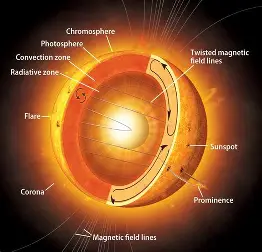
The Sun has several layers, and each one has different characteristics. At the center is the core, where nuclear fusion takes place. Surrounding the core are regions through which energy moves toward the outside.
The visible surface is called the photosphere. Above it is the chromosphere and the corona. The corona is the Sun’s outer atmosphere and extends millions of kilometers into space.
The corona can be seen more clearly during a total solar eclipse, when the bright photosphere is temporarily blocked by the Moon.
Why Sunlight Matters
Sunlight is essential for life on Earth. Plants capture solar energy through photosynthesis and use it to produce food. These plants then support animals and humans through the food chain.
Solar energy also affects the water cycle. Sunlight warms oceans, rivers, lakes, and other water sources, causing evaporation. Water vapor rises into the atmosphere and eventually contributes to clouds and precipitation.
In addition, sunlight helps create the temperature differences that drive winds and influence weather patterns around the world.
The Sun and Human Life
Human civilization has depended on the Sun since ancient times. People have traditionally used the movement of the Sun to understand the passage of time and determine seasons. Agriculture also depends heavily on sunlight because crops need solar energy to grow.
Today, people are finding new ways to use this natural resource. Solar panels convert sunlight into electricity without directly producing greenhouse gas emissions during operation. As technology improves, solar power is becoming an increasingly important part of renewable energy systems.
Solar Activity and Space Weather
The Sun is not completely calm. Its surface and atmosphere experience powerful activity, including sunspots, solar flares, and coronal mass ejections. These events can release enormous amounts of energy and charged particles into space.
When these particles interact with Earth’s magnetic field and atmosphere, they can produce beautiful auroras near the polar regions. Strong solar storms can also interfere with satellites, radio communications, navigation systems, and electrical infrastructure.
Scientists continuously observe the Sun to better understand this activity and its potential effects on Earth and space technology.
How the Sun Shapes Our Climate
The Sun is the primary source of energy that drives Earth’s climate system. Different parts of the planet receive different amounts of solar energy because of Earth’s shape and its tilted axis. This uneven heating contributes to global temperature patterns and seasonal changes.
However, Earth’s climate is influenced by many factors, including the atmosphere, oceans, land surfaces, and human activities. The Sun is an essential part of the climate system, but it is not the only factor that determines long-term climate conditions.
Protecting Our Eyes
Looking directly at the Sun can seriously damage the eyes. The brightness of sunlight can injure the retina, even when the viewer does not immediately feel pain. Special-purpose solar viewing equipment is required for safely observing the Sun.
Regular sunglasses are not designed for direct solar viewing. During a solar eclipse, proper certified solar viewing glasses or other appropriate equipment should always be used.
Conclusion
The Sun is far more than a bright object in the daytime sky. It is the central star of our solar system and the primary source of energy that supports life on Earth. Its light powers plants, drives the water cycle, influences weather, and provides energy that humans can capture through solar technology.
At the same time, solar activity reminds us that our star is a dynamic and powerful object. By studying the Sun, scientists can better understand space weather, Earth’s environment, and the wider universe. From ancient civilizations to modern space exploration, the Sun continues to play a central role in our understanding of life and our place in space.