


Largest Countries in the World: A Guide to the Biggest Nations by Area
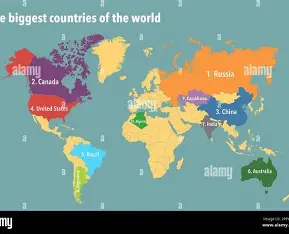
The largest countries in the world are remarkable not only because of their enormous size but also because of their diverse landscapes, cultures, climates, and natural resources. From frozen Arctic regions to tropical forests and vast grasslands, these nations cover millions of square kilometers. Their huge territories also make them important players in global geography, economics, and environmental conservation.
When countries are ranked by total land area, a few nations stand far above the rest. Let’s explore the biggest countries on Earth and discover what makes each one unique.
1. Russia
Russia is the largest country in the world, covering more than 17 million square kilometers. It stretches across Eastern Europe and northern Asia, making it the only country with territory spanning such a massive area across two continents.
Russia is famous for its enormous forests, including large parts of the Siberian wilderness. The countries also have mountains, rivers, lakes, and Arctic landscapes. Lake Baikal, located in Siberia, is the world’s deepest freshwater lake. Because of its enormous size, Russia experiences a wide range of climates.
2. Canada
Canada is the second-largest country in the world and covers nearly 10 million square kilometers. It occupies much of the northern part of North America and is known for its spectacular natural scenery.
The countries have vast forests, thousands of lakes, rugged mountains, and long coastlines. Canada also has large Arctic territories where the landscape remains frozen for much of the year. Its natural environment supports animals such as polar bears, moose, bears, and wolves.
3. China
China is the third-largest country by total area, covering around 9.6 million square kilometers. It is one of the world’s most geographically diverse nations.
China has high mountains, deserts, plateaus, forests, rivers, and fertile plains. The Himalayas rise along its southwestern border, while the Gobi Desert extends across northern areas. China is also home to one of the world’s largest populations and has a history stretching back thousands of years.
4. United States
The United States is among the largest countries in the world, with an area of roughly 9.4 million square kilometers when its territories and water areas are considered. Its geography is extremely varied.
The country contains deserts, forests, mountains, grasslands, wetlands, and coastal regions. The Rocky Mountains dominate parts of the west, while the Great Plains stretch across the central region. Alaska adds an enormous area of wilderness, and Hawaii contributes tropical islands in the Pacific Ocean.
5. Brazil
Brazil is the largest country in South America and the fifth-largest country in the world. It covers more than 8.5 million square kilometers.
Brazil is especially famous for the Amazon rainforest, one of the most biologically diverse places on Earth. The Amazon River flows through a large part of the country, supporting countless species of plants and animals. Brazil also has extensive grasslands, wetlands, mountains, and a long Atlantic coastline.
6. Australia
Australia is the sixth-largest country and the world’s largest country that occupies an entire continent. It covers approximately 7.7 million square kilometers.
The Australian landscape includes deserts, tropical forests, beaches, mountains, and grasslands. Much of the country’s interior is dry and sparsely populated, while most people live near the coast. Australia is also famous for unique wildlife, including kangaroos, koalas, wombats, and the platypus.
7. India
India covers about 3.3 million square kilometers, making it one of the world’s largest countries. Located in South Asia, India has an extraordinary variety of landscapes.
The Himalayas dominate the northern border, while fertile plains, forests, deserts, plateaus, and coastal regions can be found across the country. The Thar Desert lies in the northwest, while tropical environments occur in southern and northeastern areas. India is also known for its rich cultural and historical heritage.
8. Argentina
Argentina is the second-largest country in South America and the eighth-largest country globally. It covers approximately 2.8 million square kilometers.
Its landscape ranges from subtropical regions in the north to the cold and rugged areas of Patagonia in the south. The Andes Mountains form a natural boundary along the western side. Argentina is also home to the Pampas, a vast fertile plain that plays an important role in agriculture.
9. Kazakhstan
Kazakhstan is the world’s largest landlocked country and the ninth-largest country by area. It covers approximately 2.7 million square kilometers.
Much of Kazakhstan consists of open steppe, deserts, and semi-desert landscapes. The country is rich in natural resources and has a relatively low population density compared with its enormous territory. Its location between Europe and Asia has also given it an important role in regional history and trade.
10. Algeria
Algeria is the largest country in Africa and the tenth-largest country in the world. It covers approximately 2.4 million square kilometers.
A large portion of Algeria lies within the Sahara Desert, one of the world’s most famous deserts. In the northern part of the country, the Mediterranean coastline provides a very different environment, with greener landscapes and a milder climate.
Why Are the Largest Countries Important?
The largest countries in the world play an important role in global countries geography and environmental protection. Their enormous territories contain forests, freshwater systems, mineral resources, agricultural land, and unique ecosystems.
Large countries also have diverse populations and cultures. Their size can influence countries transportation, economic development, climate research, and international relations. Protecting their natural environments is particularly important because many contain ecosystems that affect biodiversity and the global climate.
Final Thoughts
The largest countries in the world demonstrate just how diverse and impressive our planet can be. Russia’s vast wilderness, Canada’s northern landscapes, Brazil’s Amazon rainforest, Australia’s unique environment, and the varied geography of China and the United States all show how much diversity can exist within enormous national borders.
Learning about these countries is a fascinating way to understand world geography. Their size is only one part of their importance; their landscapes, people, resources, and ecosystems make them significant parts of our global community.

Comments are closed.
[…] flows through South America and is closely connected with the Amazon rainforest, one of the most important natural ecosystems on Earth. But what makes the Amazon so remarkable, and how does it compare with […]
[…] the Sun, which is the closest to Earth, to distant stars that can only be seen with powerful telescopes, these objects help scientists understand how the universe formed and changed over […]