

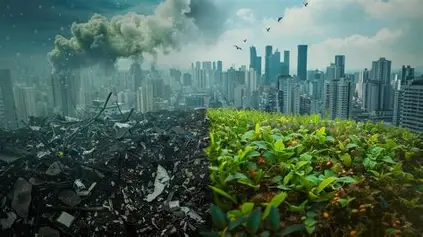

How Do Cities Impact the Environment?
How Do Cities Impact the Environment?Z Cities are major hubs of population, commerce, education, transportation, and culture.
They offer numerous opportunities and services to people but also have a large effect on the natural world. City expansion leads to greater consumption of land, water, energy, and other resources.
Therefore, what is the effect of cities on the environment? The impact of urban areas on the environment can manifest itself in multiple ways, such as air pollution, water pollution, waste generation, habitat loss, and heightened energy use. However, some of these impacts can be mitigated with well-designed cities by means of green spaces, public transport, renewable energy, and waste management.
What Are the Impacts of Cities on the Environment in Terms of Air Pollution?
Large cities come with a variety of environmental issues, and air pollution is among the biggest. Pollutants can be emitted into the air by cars, buses, trucks, factories, construction, and power plants.
Exhaust gases can be generated, and fine particles can form when vehicle concentrations are high. These pollutants can cause environmental issues and reduce air quality.
Cities could achieve this by investing in better public transport, promoting walking and cycling, investing in cleaner vehicles, and investing in cleaner energy.
How do cities shape water resources?
Cities have many applications that demand lots of water, like drinking water, cleaning, industrial, agricultural, etc. As cities are progressing and as the population grows, the demand for water can grow as well.
Rivers, lakes, and groundwater can also be impacted by urban development. Large areas of roads and built-up areas have decreased the ability of rainwater to naturally percolate into the soil. In heavy rain, runoff can also be fast on impervious surfaces and into a drainage system.
Wastewater is also an issue. Pollutants can be released into water bodies such as rivers if the wastewater is not adequately treated.
Good drainage and effective wastewater treatment can help safeguard urban water resources.
Urban growth is associated with a loss of natural habitats.
Urban development can lead to the loss of natural amenities, including parks, shopping centers, roads, and other facilities.How Do Cities Impact the Environment?
This may lead to loss of habitat for vegetation and wildlife. As urban development progresses, the forests, wetlands, grasslands, and other natural spaces can be lost and/or fragmented.
Regarding adaptation to cities, wildlife can sometimes adapt to them; in fact, some species benefit from urban environments. Many other species, however, have particular habitat needs that could be lost during development.
Preserving natural areas such as parks, wetlands, and forests can help maintain biodiversity in the city and its surroundings.
What are the impacts of waste on the environment?
A lot of waste is generated daily in cities. Cities should collect and manage household garbage, food waste, packaging waste, construction waste, and industrial waste.
Poor waste disposal or management can lead to soil and water contamination. Some plastic waste can also enter rivers and seas and endanger wildlife.
Cities can better manage their waste in a sustainable way by recycling, composting, reducing waste, and disposing of waste properly.
It’s also important to minimize waste generation. Pressure on waste management systems can be reduced by reusing materials and opting for less packaging.
Cities and Energy Consumption
Cities in general, and large cities particularly, consume a considerable amount of energy. Energy is used in homes, offices, factories, the transportation system, shopping centers, and public facilities.
So far, most of this energy has come from traditional fossil fuels like coal, natural gas, and oil. Burning fossil fuels releases GHGs into the atmosphere.
Energy efficiency and the use of renewable energy resources like solar and wind energy are ways to minimize cities’ environmental impact.
However, energy-efficient buildings, improved public transport, and modern electricity systems can also reduce energy use.
The Urban Heat Island Effect
Urban heat island (UHI) is another significant environmental impact of cities.
Cities often have significant amounts of concrete, asphalt, and other surfaces that heat up and hold the heat from the sun and can cause a city to heat up—particularly during the day and sometimes even during the night—compared to the surrounding rural landscape.
This effect may be exacerbated by the lack of vegetation.
Urban trees and other elements such as parks, green roofs, and other vegetation can help to shade and cool the surrounding environment. Such green space can also be more comfortable for inhabitants in the cities and offer space for wildlife to survive.
What can cities do to be environmentally friendlier?
Cities don’t have to be at odds with the environment. Many of the potentially adverse effects on the environment can be minimized with careful planning.
A way to do this is to make public transport more efficient. Private car use can be reduced if convenient alternatives are available.
Cities also have the opportunity to preserve and protect green spaces and to establish parks within urban areas. Trees can provide shade and biodiversity and help control stormwater.
Cities can reduce pollution from poor recycling and waste collection by improving recycling and waste management. In the meantime, cities can cut the use of fossil fuels for energy generation by building energy-efficient structures or by generating energy using renewable sources.
Through city planning, they can also promote the idea of denser settlement, which is the integration of housing, workplaces, schools, and services. This can cut down on people’s commutes and make public transport more viable.
What is the significance of sustainable urban planning?
Many cities worldwide are projected to continue expanding, and the world has become much more urban. Thus, sustainability in urban planning is more and more of a necessity.
Urban areas must be planned in a way that takes into account environmental, social, and economic needs.
With a sustainable city, there are, for example, opportunities to supply housing, transport, clean water, waste disposal, public places, etc. without unnecessarily overburdening resources.
The purpose of the policy is not to limit urbanization but to ensure it is more efficient and environmentally friendly.
Conclusion
Therefore, what is the effect of cities on the environment? Urban impact on the environment is related to cities’ land use, water, energy, and natural resource use. Urban activities may lead to emission of pollutants in the air, water, and waste; loss of habitats; and increase in temperature.
There are also steps that cities can take to reduce these effects, however. A healthy urban environment can be achieved through public transportation, renewables, wastewater treatment, and green spaces, as well as sustainable urban planning and development.
The relationship between cities and the environment will be a key requirement for growing cities. Urban development is capable of accommodating increasing populations through wise planning and proper utilization of resources without harming the environment

Comments are closed.
[…] development of human settlements can trace back thousands of years. Some originally developed as small farming settlements; others as towns along rivers, roads, ports, trade centers or places […]