


What Causes Fog? Explain the role of science in fog formation.
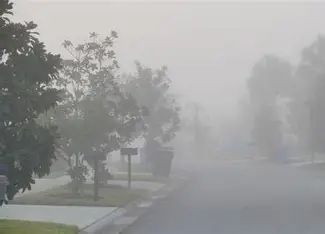
What causes fog? Fog is the result of water vapor condensing in the form of very small water drops in the moist air near the earth’s surface due to a decrease in temperature. Such droplets stay close to the ground, forming a cloud at the earth’s surface. Fog may cause roads, fields, forests, and cities to appear like entirely different places, particularly on a cool morning.
Fog can be a mystery, but it’s really a simple and fascinating aspect of the water cycle. In this article, we shall see how fog is formed and why, the types of fog, and its impact on daily life.
What Is Fog?
Fog is an accumulation of small water droplets in the air near the ground. Fog can be simply defined as ground-level clouds.
The particles of fog are very fine. They can stay aloft due to slight air currents. When lots of droplets get together, they decrease visibility and produce the well-known white/gray look of fog.
Fog may develop over land areas, in the vicinity of rivers and lakes, in coastal areas, and in low-lying areas. This is a common occurrence when moisture is in the air.
How Does Fog Form?
Fog starts with moist air at the ground level. As this air cools, it cannot contain as much water vapor.
At some point, the air cools down to a temperature that is known as the dew point. Now water vapor turns into small droplets of liquid water.
They coalesce on microscopic particles in the atmosphere, like dust, smoke, or other little particles. More and more droplets form, which spread out in the air and form fog.
This is why it’s often possible to see fog in the early morning. At night the earth’s surface cools off. The air near the ground cools down, and if there is sufficient humidity, fog forms.
Why Do Fog Occurs in Dawn Time?
Fogs are particularly frequent in the morning, as nighttime cooling is an important factor.
Once the sun sets, the temperature starts to drop. Also, the layer of air just above the ground cools down. If this air has sufficient moisture, then it can reach its dew point.
This causes the water vapor to condense into fine droplets and fog to form.
The warmed air and ground during the day, when the sun is up. The fog droplets may then evaporate, causing the fog to disappear.
This is why some mornings may be foggy but clear off within a few hours.
Why Does Fog Form close to Rivers and Lakes?
Fogs can be produced by an adequate amount of moisture from large water bodies. Evaporation of water vapor from rivers, lakes, and wetlands continually replenishes the amount of water vapor in the atmosphere.
The moisture can condense and form fog when the air above or near the water is sufficiently cold.
This kind of fog is frequently observed around lakes and rivers, usually on cool mornings. Moisture and temperature differences combine to make for good fog conditions.
Fog—Different types of fog.
Fog comes in several forms, and each form forms under slightly different conditions.
Radiation Fog
Radiation fog occurs when the ground cools at night and cools the air close to the ground. It is particularly frequent on nights with clear skies and little wind.
It is a typical early morning fog that forms in valleys and open areas.
Advection Fog
Advection fog forms by warm moist air being advected into cooler air. As the air flows over that surface, it cools and can reach its dew point.
This kind of fog is common in coastal areas where warm air flows over cool ocean or cool land.
Valley Fog
Valley fog is typical of low-lying areas and valleys. These areas can accumulate cold, dense air, and moisture can get trapped near the ground.
This means that valleys can actually be foggy when higher areas are clear.
Evaporation Fog
Evaporation fog may develop if moisture enters the colder air above the relatively warm surface of the water. The water vapor being added will add humidity, and if enough condensation occurs, fog may form.
This can occur over lakes, rivers, or other waters under favorable weather conditions.
How Does Fog Impact on sees?
Fog is one of the most significant impacts, as it lowers the visibility.
The fog consists of numerous micro droplets of water, which scatter light. Objects that are distant cannot be seen easily when the concentration of the droplets gets high.
Heavy fog can make roads slippery to drive on because of low visibility. Also impacts airports, ships, and other transportation.
During times of reduced visibility, drivers should reduce speed, use vehicle safety lights, keep an adequate space cushion, and be extra vigilant about reading the road signs.
What is Fog? Is it a cloud?
Fog and clouds can be compared to each other, but the only difference is the location.
The cloud develops at higher altitudes, and the fog is close to the surface of the earth. They are both composed of water droplets and/or ice crystals in the air.
In fact, fog can be said to be a cloud on the ground.
Fog and cloud formation is based on the same basic process: cooling, condensation, and moisture.
Why does Fog go Away?
Under most circumstances, fog dissipates when the conditions that produced it (that led to its development) change.
The most often cited is because of the warming of the sun. As the temperature of the ground and air increases, the tiny water droplets can evaporate back into the water vapor.
Wind can also aid in the removal of fog by the mixing of cool moist air with warm and dry air.
Fog may be persistent if the air is relatively calm, cool, and humid.
Is Fog Important?
Fog can create challenges for transportation; however, it is also a part of natural ecosystems.What causes fog?
Fog can be an important source of moisture for plants in some areas. This can help to provide an extra source of water in areas with low rainfall.
Fog also plays a role in the local humidity and in the water cycle. Fog has important implications for coastal and mountainous systems with respect to the support for plants and wildlife.
Final Thoughts
What causes fog? Fog is a condensation of the water vapor in moist air near the surface of the Earth when cooling of the air brings it to its dew point. These droplets exist in the air close to the ground and do produce a visible moisture layer.
Fog may form in several different ways: by night-time cooling, by touching a cold surface, or by moisture from water in the vicinity. While fog can lower visibility and pose problems for transportation, it is also an interesting element of the earth’s atmosphere.
So, when you wake up in the morning next, and see a fog, remember you are observing a cloud that has developed very close to the ground. Having knowledge of the reasons for fog enables us to gain a greater appreciation of the science behind everyday weather

Comments are closed.
[…] are a major part of Earth’s natural processes. They don’t just store massive amounts of freshwater—they also help shape the surface of our […]