


How Are Clouds Formed? The Science Behind Clouds
Introduction
Did you ever ask yourself while out in the sky, how do clouds form anyway? Clouds are composed of tiny water droplets or ice crystals, though they may appear to be piles of soft-white, fluffy masses floating high in the sky. They are created when warm, humid air ascends into the atmosphere, cools and when water vapor reaches a certain temperature, it condenses.
An important process of the water cycle is cloud formation. Clouds contribute to water cycling and are a critical component in precipitation, snow cover, storms and changes in weather.
What Are Clouds?
Clouds consist of a large number of small water droplets, ice crystals or a combination of both, suspended in the atmosphere. From the bottom of the cloud, it may appear solid, but it is composed of very small particles.
Water on the surface of the Earth is continually transformed to water vapor by evaporation. With warm air this vapor rises into the atmosphere. The altitude of the air, the colder it is, in general. Finally, the water vapor can condense into small liquid droplets and/or ice crystals.
These very small particles cluster onto microscopic particles (condensation nuclei). Dust, salt, smoke and other particles in the atmosphere can serve as surfaces onto which water vapor can condense.
The Role of Evaporation
Evaporation is a first step in the formation of clouds. Oceans, rivers, lakes, soil and other sources of water get hot from the Sun. Some of this liquid water becomes invisible water vapor and evaporates to the atmosphere.
There is special importance in the oceans because they have a wide area of Earth’s surface and release large quantities of moisture. There is also a process called transpiration in which plants put water vapor in the atmosphere.
These together constitute the addition of moisture to the air by evaporation and transpiration. Moist air rises and cools to the proper conditions for the formation of clouds.
Why Does Warm Air Rise?
The warm air will tend to rise relative to cooler air, as warm air has a lower density. Moist air can move aloft in a number of ways.
For instance, convection of warm air may occur due to sun heating the ground. When moving air strikes the slopes of mountains, it can be forced up, too. Weather systems and the confluence of air masses also can lift air to higher altitudes.
Air pressure reduces as it goes to a higher altitude. As the air is rising, it is cooling down. This cooling can ultimately cause condensation if sufficient amounts of moisture are available.
Condensation and Cloud Formation
One key stage in the process is called condensation. When warm air cools, some of the moisture in the air may condense, and the temperature drops to the dew point, where the air is saturated with water vapor.
Water vapor starts to condense to form small droplets at this point. The droplets condense onto small particles that are present in the atmosphere, such as dust and salt.
Billions of these tiny droplets or ice crystals may coalesce and form a cloud that is visible.
This is why it is possible for clouds to form even though water vapor cannot be seen. When the water turns into very small droplets or ice, they scatter sunlight, and you can see the water.
Why Are Some Clouds White?
Because the water droplets and ice crystals in a cloud are so small, they scatter sunlight in lots of different directions, hence appearing white. The sun contains a lot of visible colours, so the scattered color is typically white.
But clouds can be grey or dark as well. The higher density of thick clouds results in greater blockage and scattering of sunlight, which results in less reaching the ground. This can cause their bottoms to be a grey or almost black color.
This is particularly prevalent with very dense rain clouds prior to and during heavy rain.
Different Types of Clouds
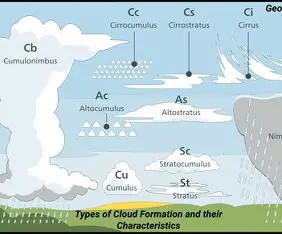
Clouds are of various shapes and sizes. Based on their appearance and the altitude, they are classified by scientists into different groups.
Cumulus clouds are sometimes large, puffy clouds with rounded tops. They are normally seen on days of fair weather, and some of them can produce strong storm clouds.
Stratus clouds are composed in extensive, undulating layers which completely fill the sky. Cloudiness or haze is a frequent occurrence from them.
Cirrus means ‘curl of hair’ clouds; they are thin and wispy and located at high altitudes. At these altitudes it is very cold and is primarily composed of ice crystals.
Cumulonimbus clouds are the cumulative thunderstorm clouds, tall and powerful, that are correlated with thunderstorms, heavy rainfall, lightning, heavy winds and so on.
Each cloud type gives information about the weather conditions and what is likely to occur.
How Do Clouds Produce Rain?
Rainfall is not necessarily associated with clouds. In order to rain, droplets of water in a cloud need to become large enough to start falling toward the earth’s surface.
The tiny droplets can come into contact and fuse with other droplets. As with time, they grow bigger and heavier. They fall as precipitation when they are too heavy to be held aloft by air currents.
Precipitation can be rain, snow, sleet or hail depending on the temperature of the air.
This process is a direct link between clouds and the water cycle and also allows for the transport of fresh water around the globe.
Why Do Clouds Form at Different Heights?
Clouds can be found at various heights because of the changes in atmospheric temperature, pressure and moisture with height.
High-level clouds can consist primarily of ice crystals. Low-level clouds tend to be liquid-water clouds, and in the middle cloud layer, the clouds can consist of either liquid water droplets or of ice particles.
The altitude of a cloud may also determine the kind of weather that it brings.
Clouds and the Water Cycle
Clouds play an integral role in the water cycle of the earth. Linkages between the surface, the atmosphere and land keep water continually in motion.
Evaporation is the process of energy being transferred from the sun. The moisture evaporates into air, cools and results in clouds. Later, water is once more added to the surface of the Earth through precipitation. The way the cycle is then allowed to repeat is through rivers, lakes, underground water and oceans.
If this flow of water ceased, Earth, with its living creatures, would be quite different.
Conclusion
So, how are clouds formed? The cycle starts with evaporation from the Earth’s surface, which goes up to the atmosphere as water vapor. Moist air rises, expands and cools. Provided that the conditions are right, the water vapor will condense onto small particles, creating numerous microscopic droplets and/or ice crystals. It is these particles that in aggregate form clouds.
Clouds are more than just pretty pictures in the sky. These play a key role in the earth’s weather and water cycle. They allow scientists to study them, understand atmospheric conditions and predict the weather as well as gain more knowledge about the movement of water around our planet.

Comments are closed.
[…] When thunder and lightning are observed. Most thunderstorms will also include rain, though some thunderstorms can result in very little rain on the […]