


How Do Volcanoes Form? A Simple Guide to Volcano Formation
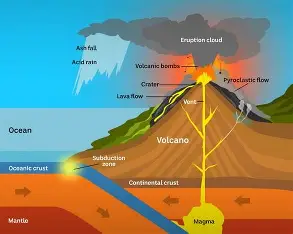
How do volcanoes form? Volcanoes form when hot molten rock called magma rises from deep inside the Earth and reaches the surface. This process is closely connected to the movement of tectonic plates and the intense heat found beneath Earth’s crust. Over time, repeated eruptions can build layers of lava, ash, and other volcanic materials, creating a volcano.
Volcanoes are among the most powerful natural features on our planet. They can create new land, change landscapes, and release gases and minerals from deep within Earth.
What Is a Volcano?
A volcano is an opening or weak point in Earth’s crust through which magma, gases, ash, and rock fragments can escape to the surface.
Deep beneath the ground, extremely high temperatures can melt some rocks and form magma. When pressure pushes this magma upward, it may find cracks or openings in the Earth’s crust.
Once magma reaches the surface, it is called lava. The lava can flow across the land and gradually cool into solid rock.
How Do Volcanoes Form?
The formation of a volcano usually begins deep beneath Earth’s surface. Heat and pressure can cause rocks in the mantle to melt partially, producing magma.
Because magma is often less dense than the surrounding solid rock, it tends to rise. As it moves upward, pressure can build inside underground chambers and cracks.
If the pressure becomes strong enough, magma can break through the Earth’s crust. An eruption occurs when magma, gases, ash, and rock materials reach the surface.
Repeated eruptions can leave layers of volcanic material around the opening. Over many years, these layers may form a volcanic mountain.
The Role of Tectonic Plates
Tectonic plates play an important role in the formation of many volcanoes. Earth’s outer shell is divided into large plates that slowly move over the hotter material beneath them.
When these plates interact, conditions can develop that allow magma to reach the surface.
One important setting is a convergent plate boundary, where one plate moves beneath another. This process is called subduction. As the descending plate moves deeper into Earth, water and other materials can contribute to melting in the surrounding mantle. The resulting magma may rise and eventually form volcanoes.
Another setting occurs at divergent plate boundaries, where tectonic plates move away from each other. As the crust separates, magma can rise from below and fill the gap.
Volcanoes at Hotspots
Not all volcanoes form at tectonic plate boundaries. Some develop above areas called hotspots.
A hotspot is a region where unusually hot material from deep within Earth’s mantle rises toward the surface. When this hot material melts surrounding rock, magma can form and rise through the crust.
As a tectonic plate slowly moves over a hotspot, a series of volcanoes may form over time.
This process can create chains of volcanic islands and other landforms.
What Happens During a Volcanic Eruption?
A volcanic eruption occurs when magma and gases escape from inside Earth.
Before an eruption, magma may collect in an underground chamber. As magma rises, dissolved gases can expand and increase pressure.
Eventually, the pressure may become strong enough to push material through cracks or openings in the crust.
Some eruptions produce slow-moving lava flows. Others can release large amounts of ash, gas, and fragmented rock into the atmosphere.
The type of eruption depends on factors such as magma temperature, chemical composition, viscosity, and gas content.
Different Types of Volcanoes
Volcanoes come in different shapes and sizes. Their appearance depends partly on the type of lava and volcanic material they produce.
Shield volcanoes have broad, gently sloping sides. They usually form from fluid lava that can travel long distances before cooling.
Composite volcanoes, also called stratovolcanoes, are generally tall and steep. They often contain alternating layers of lava, ash, and other volcanic materials.
Cinder cone volcanoes are usually smaller. They form when pieces of volcanic rock and ash accumulate around a volcanic opening.
Each type tells us something about the volcanic processes that shaped it.
Can Volcanoes Create New Land?
Yes. Volcanoes can create new land when lava reaches the surface and cools into rock.
Repeated eruptions can gradually build volcanic islands, mountains, and other landforms. In some places, underwater volcanic activity can eventually rise above sea level and create an island.
Volcanic activity has therefore played an important role in shaping Earth’s surface throughout geological history.
Why Are Volcanoes Important?
Although volcanic eruptions can be dangerous, volcanoes also provide important benefits.
Volcanic materials can break down and create mineral-rich soils that support agriculture. Volcanoes can also release minerals from deep inside Earth and contribute to the formation of valuable geological resources.
In addition, volcanic activity helps scientists understand what is happening beneath Earth’s surface.
Volcanoes are also important to Earth’s long-term geological processes because they transfer heat and materials from the interior toward the surface.
Where Are Most Volcanoes Found?
Many volcanoes are located around tectonic plate boundaries. A famous region is the Pacific Ring of Fire, which surrounds much of the Pacific Ocean.
This region contains numerous volcanoes and experiences frequent earthquakes because several tectonic plates interact there.
However, volcanoes can also occur away from plate boundaries because of hotspots and other geological processes.
How Do Scientists Monitor Volcanoes?
Scientists carefully monitor active volcanoes to identify changes that may indicate rising magma.
They can measure earthquakes, ground movement, gas emissions, temperature changes, and other signals.
These observations can help scientists understand volcanic activity and provide warnings when the risk of an eruption increases.
However, predicting the exact time and size of an eruption remains difficult.
Conclusion
So, how do volcanoes form? They form when magma rises from inside Earth and breaks through the crust. Tectonic plate movement, subduction zones, divergent boundaries, and hotspots can all contribute to volcanic activity.
Over time, repeated eruptions can build mountains, islands, and other landforms. While volcanoes can be destructive, they are also an important part of Earth’s natural geological system.
By studying volcanoes, scientists can learn more about the forces operating deep beneath our feet and better understand how Earth continues to change.


Comments are closed.
[…] contains gases such as nitrogen and oxygen, along with tiny amounts of water vapor, dust, and other particles. When sunlight enters the atmosphere, it interacts with these molecules. This interaction creates […]