

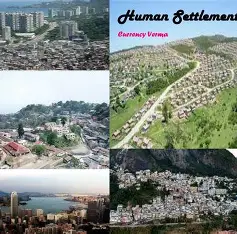

Human settlements come in various forms.
Types of Human Settlements: Hamlets, Villages, Towns & Cities Human settlements are places where people live, work and build communities. They may consist of just a handful of houses, or they may have millions of people.
Which kinds of human settlements exist? This varies from settlement to settlement depending on population size, location, economic activities, etc.
The development of human settlements can trace back thousands of years. Some originally developed as small farming settlements; others as towns along rivers, roads, ports, trade centers or places where significant natural resources were available. At present, settlements may be broadly considered rural or urban, and there are various types of each.
What is a PSHE?
A human settlement is a location where human beings set up their homes and conduct their day-to-day life. Residents can be found in a settlement living, working, farming, trading, studying and using public services.
Settlements may large or small, and they may consist of one or more buildings. A small rural community could have just a few families, or there could be millions of people in a large metropolitan area.Types of Human Settlements: Hamlets, Villages, Towns & Cities
Settlement patterns are also affecting the physical surroundings. The availability of water, fertile land, transportation and natural resources may influence where people live.
1. Hamlets
The hamlet is one of the smallest forms of a human settlement. It is typically a collection of a few homes and may lack many services or facilities.
Hamlets are typical in country places. Residents might rely on local agriculture, livestock, fishing or other local economic activities.
A hamlet may not have an administrative Centre, market, hospital or its own school. One can go to a nearby village/town to avail these services.
2. Villages
In general, a village is larger than a hamlet and has a more developed community.
Villages have traditionally developed around agriculture. Farmers can plant crops, raise animals or engage in other businesses associated with the local economy.
Most villages have rudimentary services like schools, small stores, temples, churches, community centers or markets.
The features and dimensions of a village vary across regions. In some countries, villages may have thousands of people.
3. Towns
A town is larger and more built up than a typical village. Towns typically offer a greater diversity of services, businesses and jobs.
People in towns could work in shops, offices, factories, schools, health care, transportation and more.
Towns are centers of service for the surrounding rural population. Producers from nearby villages might go to a town to sell their produce or purchase something, visit banks or go to government offices.
Some spring up swiftly because they are situated near important roads, railway stations, rivers, or industrial zones.
4. Cities
A city is a human settlement, typically larger and more developed than a town, characterize high population density and a large number of buildings, businesses and services.
Typically, a city has complex transportation and a variety of facilities. Theeran includes universities hospitals Government buildings Shopping centers Industries Airports anticultural institutions,
Cities tend to be hubs of economic and political activity. They draw in population from other areas due to employment opportunities, education, etc.
But fast-growing cities also face challenges such as traffic congestion, pollution, housing shortages and strain on infrastructure.
5. Metropolitan Areas A metropolitan area is a large area of urban development that consists of a main metropolitan area with adjoining towns, suburbs and communities that have a strong connection to the central area.
Individuals can work or study in one place while residing elsewhere in the metro area. Roads, railways, and public transportation connect these communities.
The geographic area of a metropolitan area may be quite large and may include millions of people. They tend to be very interwoven in terms of economy and infrastructure.
Rural and Urban Settlements
There are also two broad categories of human settlements, namely, rural settlements and urban settlements.
Rural settlements – typically found in rural areas. Rural economies may be dependent on a wide range of land-based activities, such as agriculture, fishing and forestry. In general, the population density is less than in urban areas.
Urban settlements include towns and cities, which are characterize higher population density. People work in various industry fields such as manufacturing, trade, education, health care, finance, technology and services.
There may be no distinct demarcation between rural and urban areas. Some places have aspects of both.
Different Settlement Patterns
Another way of defining human settlements is based on how they are physically configured, or settlement pattern.
In a nucleated settlement, buildings are closely grouped. It may form around a market, water source, crossroads or any significant place.
Linear settlements are found along roads, rivers, railways, coasts or valleys. The buildings (including houses) are set out in a reasonably long line.
In a dispersed settlement, houses are more spread out. This can be seen in some agricultural areas where houses are set near to individual fields and/or properties.
Geography, land availability, transportation, and economic activities affect these patterns.
Talk about the reasons for the variation between human settlements.
No single reason explains why one settlement develops differently. Geography matters, but economic, historical, cultural, and technological factors also influence development.
The functions of a settlement near a river could be fishing, farming and transportation. A mineral resource may lead to a settlement’s growth near it. Meanwhile, a settlement near a main road may grow into a vital center for transportation and commerce.Types of Human Settlements: Hamlets, Villages, Towns & Cities
The size and role of settlements can also change over time because of technological and economic changes.
Conclusion
Therefore, what are the various kinds of human settlements? Human settlements vary from small hamlets and villages to towns, cities and large metropolitan areas. They may also be termed rural or urban and be characterized as nucleated, linear or dispersed settlements.Types of Human Settlements: Hamlets, Villages, Towns & Cities
To understand the development and form of a settlement, many factors need to be taken into consideration – physical geography, natural resources, transport, economic activities, population and history.
Understanding the different kinds of human settlements enables us to know Thow people organize their communities and how human life relates to the geography of our settlement


Comments are closed.
[…] mountains and valleys, earthquakes and volcanoes. It is the basis for explaining many of the natural forms and phenomena around us. Geology can also help geologists determine how the Earth might […]