

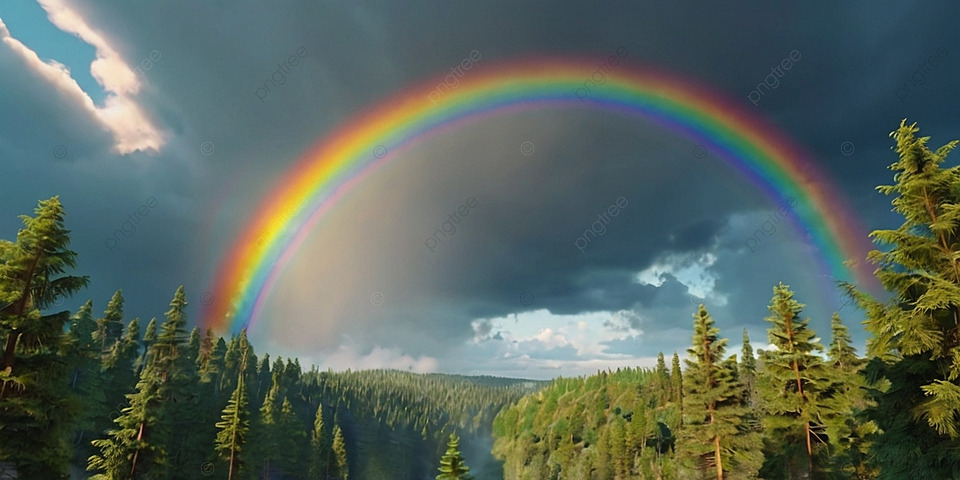

Rainbow: How and why does a rainbow appear in the sky?
Rainbow is one of the most beautiful natural phenomena that we can observe in the sky.
Typically forms when it rains and the sun shines through water droplets in the air.
The light refracts, reflects and separates into different colors making the familiar arc of light.
A rainbow is an interesting optical phenomenon, which is made up of several interesting optical processes.
What Is a Rainbow?
The rainbow is a natural phenomenon that is formed by the interaction of the sun’s rays and water droplets.
The light is bent on entering the raindrop, reflected in the drop and exits from it in another direction.
The sun is white and in the white sunlight are many colors. These colors separate when they pass through water, each color bends slightly differently.
This process is called dispersion.
The colors of that we see every day are red, orange, yellow, green, blue, indigo and violet.
The color red typically is found on the periphery, and violet is found in the center.
How do rainbows form?
In the formation of rainbow, the following three processes are involved, namely refraction, reflection and dispersion.
Firstly, sunlight enters a water droplet. The light refracts when it passes from air to water. This flexing is referred to as Refraction.
Then some of the light is reflected off the inside of the water droplet. The light then propagates back towards the exterior of the droplet.
Lastly, when the light comes out of the droplet, it bends again. In the process, the various colors migrate away from each other.
If the water droplets are grouped together in millions and the sunlight strikes the sky at an angle the right angle, a color arc can be seen in the sky.
Why is there a rainbow with seven coolers?
The light from the sun is white but is actually a mixture of all the visible colors. Different wavelengths bend slightly different in water and,
hence, each color has a different wavelength.
The longest wavelength is the red light, and red bends less than violet. Violet is bent more and has a shorter wavelength.
The other colors visible are between these two.
This splitting up of the white light into various colors results in the well-known series:
Red, Orange, Yellow, Green, Blue, Indigo and Violet.
These colors flow together and a rainbow doesn’t have distinct lines between colors.
When Can You See a Rainbow?
Rainbows appear most frequently when sunlight is refracted in raindrops in the atmosphere.
This is the explanation why they’re frequently seen following a rain shower.
Usually, the Sun is behind the observer while rain or water droplets are in front of the observer. There should also be a relatively low position in the sky.
That’s why it’s not always possible to see rainbows during the day at midday.
Rainbows may also be seen around waterfalls, fountains and areas where the fine droplets of water are found in the air.
When the droplets are in these conditions, the sun can also interact with the droplets and give the same optical effect.
Why is a rainbow an arc?
A rainbow is typically a curved arc as seen from the ground. The shape is related to the geometry of the light reaching the eyes though.
Some wavelengths of light are directed towards an observer at an angle from each water droplet.
The shape of a circle is formed by millions of droplets at various positions.
Sometimes the circle is seen, more than the familiar arc, when viewed from a height above the ground, such as viewing a rainbow from an airplane.
Can 2 rainbows happen at the same time?
Yes, it is sometimes possible to see two rainbows at the same time. The brighter is known as the primary rainbow.
Outside this can be seen a secondary rainbow which is fainter than the primary one.
A secondary rainbow is an additional rainbow that is created when sunlight reflects twice in a drop of water before reaching the observer.
Due to this additional reflection, its colors are inverted.
The secondary rainbows are generally fainter and broader than the primary rainbows. Between the two rainbows there may also be a darker area than the rest of the sky.
Why Can’t We Touch a Rainbow?
A rainbow can appear as an object in the sky, but it isn’t a permanent object. It is an optical phenomenon brought about by sunlight, water droplets and the observer’s perspective.
The rainbow’s location moves as well if you move! This is why you can’t walk towards a rainbow and touch the end of it.
Indeed, two people in two positions can view different rainbows due to the different set of water droplets from which the light comes in both instances.
Rainbows have fascinated people for thousands of years.
The rainbow has been a captivating phenomenon for thousands of years. Here are a few interesting facts:
created by sunlight and water droplets.
Color of the primary rainbow is normally red outside, violet inside.
A secondary rainbow is the opposite color order.
Rainbows are not only seen after rain but can also be seen next to waterfalls and fountains.
don’t appear unless the light, water droplets and viewing angle are all correct.
Sometimes a full circle rainbow can be seen from a high altitude.
A rainbow will appear to move about when the observer moves.
Conclusion
This is a beautiful example of what natural elements can do when placed together in the right manner, the rainbow.
It is the combination of the sunlight, water droplets and just the right angle of viewing that causes the rainbow colors to appear in the sky.
Refraction, reflection and dispersion of light is responsible for the formation of a rainbow.
This sight may last only a few minutes but it’s a very interesting lesson in light and in the atmosphere.
When you see a rainbow after rain next time, remember there are millions of tiny droplets of rain and millions of photons of sunlight interacting in what is an optical phenomenon.


Comments are closed.
[…] of a large number of small water droplets, ice crystals or a combination of both, suspended in the atmosphere. From the bottom of the cloud, it may appear solid, but it is composed of very small […]